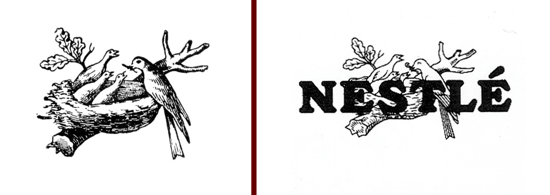
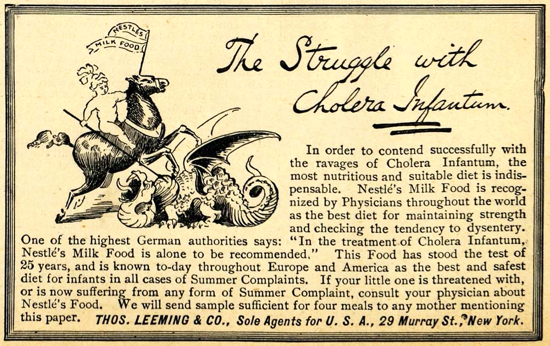
Nestlé logo 1868 (left) and 1938 (right). Henri Nestlé used his family's crest (Nestlé = little nest in German) as inspiration for the brand; later, lettering and logo were combined to become the unifying distinguishing mark for different Nestlé products.
Henri Nestlé (Frankfurt, Aug. 10, 1814 - Montreux, July 7, 1890), confectioner, inventor of the "Farine Lactée Nestlé" and founder of the Nestlé company
Name: "Farine Lactée Nestlé"
Category: Food
Subcategory: Baby food
Inventor: Henri Nestlé
Invented: 1867 - Vevey, Switzerland
Producer: "Anglo-Swiss Condensed Milk Company" (founded by Charles Page and George Page in 1866 - Cham, Switzerland), merged in 1905 with "Société Farine Lactée Henri Nestlé" (founded by Henri Nestlé on March 8, 1875 - Vevey, Switzerland, under new ownership) to become "Nestlé and Anglo-Swiss Condensed Milk Company".
Production start: 1867 - Vevey, Switzerland
Features: Farine Lactée Nestlé was a mixture of cow's milk, wheat flour and sugar, for consumption by infants who could not be breastfed. The German-Swiss pharmacist Henri Nestlé invented this formula to combat the raging infant mortality prevalent at the time, in close cooperation with his friend Jean Balthasar Schnetzler, a Swiss naturalist. His model was Justus von Liebig, a German scientist who at that time developed a soluble food for babies: «Liebig first kindled the flame of truth about human nutrition. He also drew up the requirements for his infant paste. It is an excellent product but far too difficult to prepare, requiring as it does half an hour of complicated cookery. Furthermore, the mother had to obtain the finest quality flour, malt, milk, and potash, which is certainly no small task. (...) My product is prepared entirely on Liebig's principles, only I reach the same goal by other means» (Henri Nestlé, 1868). Ready to use, Farine Lactée Nestlé needed only to be boiled prior to feeding; thus, it soon proved to be a viable substitute for breast milk for infants who were unable to be breastfed.
Nestlé's name appeared in advertisements and on labels in association with the name of the product: "Farine Lactée Nestlé" in French, "Nestlé's (Milk) Food" (USA and Australia), "Nestlé's Bread and Milk Flour" (Britain), "Harina Lacteada Nestlé" (Spain), "Nestlé's Kindermehl" (Germany).
Interesting facts: In 1866 the Anglo-Swiss Condensed Milk Company was established in Cham, Switzerland, by the American brothers George and Charles Page, to market their "Milkmaid" condensed milk as a safe, long-lasting alternative to fresh milk. In 1867 Henri Nestlé developed his "Farine Lactée", and soon began marketing it as baby food for consumption by infants who cannot be breastfed. In 1905 this two companies, after years of fierce competition during which both selling rival versions of the other's original products (condensed milk and infant cereal), merge to form the Nestlé and Anglo-Swiss Milk Company. Before this, in 1875, Henri Nestlé retired and sold his company to his business associates, but the company retained his name as Société Farine Lactée Henri Nestlé; by the same year, Nestlé's products were sold everywere from Indonesia to Egypt, and from the US to Argentina. When Nestlé and Anglo-Swiss merged in 1905, the company had more than 20 factories, and started using overseas subsidiaries to establish a sales network that included Africa, Asia, Latin America and Australia; over 150 years since its foundation, Nestlé results the largest food company in the world, with a range of products including baby food, medical food, bottled water, breakfast cereals, coffee and tea, confectionery, dairy products, ice cream, frozen food, pet foods, snacks...
Quote (Henri Nestlé, 1878): «My invention is not a new discovery but a correct and rational application of substances long known to be the best for the feeding of children. The chief ingredients are quality milk, bread and sugar».
Nestlé newspaper advertisement (Evening star, Washington, D.C., March 25, 1872). «MOTHERS, SAVE YOUR INFANTS. NESTLE'S LACTEOUS FARINA, THE MOTHER'S MILK SUBSTITUTE. Extensively used and recommended by the most eminent physicians. Sold by Druggist and Fine Grocers. B.W. REED & SONS, Agents for the South, 1214 F street northwest, Washington, D.C. Send for memorial on the Nutrition of Infants, by Henri Nestlé, Chemist. Furnished gratis. m20 12t».
Nestlé newspaper advertisement (Chicago daily tribune, Chicago, Ill., July 13, 1880). «NESTLE'S MILK FOOD. Manufactured solely by Henry Nestlé, Vevey, Switzerland. Contains only milk, wheaten bread-crust, and sugar, and requires only water to prepare it for use. Recommended by all family physicians as a certain preventive of cholera infantum and summer complaints. Pamphlets with full particulars sent to any address. Kept by druggist and grocers. Thomas Lemming & Co., Montreal, Canada».
Nestlé newspaper advertisements (Boletín mercantil de Puerto Rico, San Juan, P.R.; top: January 25, 1882 / bottom: March 4, 1888)
Nestlé factory in Vevey, Switzerland (ca. 1890)
Nestlé milk arrival in Cham, Switzerland (ca. 1890)
Farine Lactée Nestlé, early tins (German packaging, left ca. 1875, right ca. 1890)
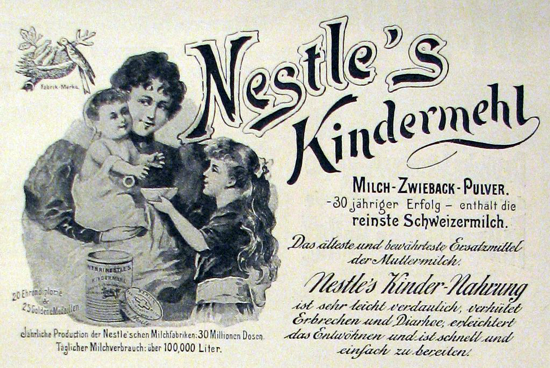
Nestlé advertisement (1891): «The Struggle with Cholera Infantum»
Nestlé advertising (1893)
Nestlé advertising (1897, art by Alphonse Mucha)
Nestlé advertisement (Illustrirte Zeitung Leipzig und Berlin, August 11, 1898)
Nestlé advertisement (Paris-Noël, December 1900): «Farine Lactée Nestlé, 30 ans de succès»
Nestlé celebrates 150 years (1866-2016) with a series of events around the world, and inaugurating its "Nest" (June 2, 2016), an interactive Museum in Vevey, the Swiss city where the first factory was built.
S.S. Jaguar logo 1935. The first car launched with the Jaguar brand was the "S.S. Jaguar 2.5 litre Saloon", unveiled at the Mayfair Hotel London, September 21, 1935; but the first car ever produced by the same company - S.S. Cars Limited, later Jaguar Cars Limited - was the 1932 "S.S. 1", or "S.S. One", debuted at the London Motor Show in October 15 to 24, 1931.
Name: "S.S. 1"
Category: Cars
Subcategory: Sports car
Designers: William Lyons and William Walmsley
Producer: S.S. Cars Limited (founded by Sir William Lyons on October 26, 1933, as the result of the Swallow Sidecar Company formed with co-founder William Walmsley on September 2, 1922)
Production start:1932 - Foleshill, Coventry, England - Debut as coupé car at the London Motor Show in October 15 to 24, 1931, Olympia, West Kensington
Discontinued: 1936
First price: 310 GBP
Features: For detailed specifications see the 1931 official brochure in Pdf below
Interesting facts: In 1922, two motorcycle enthusiasts, William Lyons and William Walmsley, founded the Swallow Sidecar Company, a British manufacturer of motorcycle sidecars and automobile bodies in Blackpool, Lancashire (later Coventry, Warwickshire). After some name changes - Swallow Sidecar and Coachbuilding Company, and Swallow Coachbuilding Company, during which the company diversified by bodying existying cars with more fashionable coachworks, William Lyons decided to become a car manufacturer in his own right. So, in October 1931, Lyons revealed his "S.S. 1" coupé at the London Motor Show. The engines and chassis supplied by the Standard Motor Company were fitted with Swallow bodies styled under Lyons supervision. The body was ultra low and the bonnet outrageously long. It had, stated the press, the £1,000 look, yet was priced at a very modest £310, highlighting Lyons' unique ability to offer remarkable value for money. The first two S.S. cars available to the public was the 1932 S.S. 1 with 2-litre or 2.5-litre side-valve, six-cylinder engine and the S.S. 2, a smaller version based on the Standard Nine chassis, with a four-cylinder 1-litre side-valve engine. A much improved S.S. cars followed in 1933, Saloon and Tourer models were introduced, and in the same year William Lyons formed S.S. Cars Limited. Jaguar brand first appeared in September 1935, as a model name on an S.S. 2.5-litre saloon presented at the Mayfair Hotel London. The company's name changed from S.S. Cars Limited to Jaguar Cars Limited in 1945.
S.S. 1 announcement (The Autocar magazine, July 1931). «WAIT! THE "SS" IS COMING - 2 New Coupés of Surpassing Beauty. - S.S. is the new name of a new car that's going to thrill the hearts of the motoring public and the trade alike. It's something utterly new ... different ... better! Long ... low ... very low ... and very FAST! At the Show, or before, two S.S. Coupés of surpassing beauty will be presented. WAIT ... THE S.S. IS COMING» - The show to which the announcement referred was the London Motor Show, Olympia, West Kensington, where the S.S. 1 debuted together with a smaller version called S.S. 2, October 15 to 24, 1931.
S.S. 1, the first car by S.S. Cars Ltd., later Jaguar Cars Ltd. (1932, restored)
S.S. 1 official brochure in Pdf (1931)
S.S. 1 advertisement (The Autocar magazine, June 10, 1932)
S.S. Jaguar 2.5 litre Saloon, the car that inaugurated the Jaguar brand (1935)
S.S. Jaguar 2.5 litre Saloon, debut at the Mayfair Hotel London (September 21, 1935)
S.S. Jaguar 2.5 litre Saloon advertisement (The Autocar magazine, October 18, 1935)
Sir William Lyons (Blackpool, Sept. 4, 1901 - Warwickshire, Feb. 8, 1985), known as "Mr. Jaguar", entrepreneur, co-founder of the Jaguar company, and designer of the early Jaguar models
Jaguar 75th Anniversary (1935-2010). On September 18, 2010, 75 iconic Jaguars started a two-day trek in Coventry to celebrate 75 years of Jaguar brand history.
Background and characters: «An evil shroud covers the world in darkness. You must restore the powers of earth, wind, fire and water to the Four Orbs. Create your own band of 4 Light Warriors from fighters, thieves, martial artists, and magicians. You'll need all their skills to triumph in this massive role-playing adventure. Your treacherous journey takes you to all parts of a strange new world. Explore dangerous castles and dark caverns where deadly perils, and great rewards await at every turn. Hundreds of ferocious monsters block your path. With patience, skill, and cunning you can defeat them. Come, begin your quest. Enter an enchanted new World. Command your warriors! Prepare to face the Final Fantasy! A world shrouded in the darkness of evil. Your mission – to restore the light». (From the North America version, 1990, back cover).
Music by: Nobuo Uematsu
Features:Final Fantasy, known as Final Fantasy I or FF1 in re-releases, was the first role-playing game in Square's Final Fantasy series, created by Hironobu Sakaguchi. For detailed features and game mode refer to the "Explorer's Handbook" below.
Interesting facts:The creator of the Final Fantasy series Hironobu Sakaguchi proposed the role-playing game (RPG) to his employer Square, but the company approved the launch only after the success of the RPG Dragon Quest by Enix. The team of developers wanted a title that had a simple abbreviation in the Latin alphabet (FF) and a four-syllable abbreviated Japanese pronunciation ("efu efu"); the first name proposed for the video game was "Fighting Fantasy", but it was already taken by a tabletop game, so they decided to call it "Final Fantasy". Final Fantasy was first released in 1987 in Japan by Square, and then Nintendo of America translated the game into English and published it in North America in 1990.
Slogan (North America version, 1990, box):«Enter a whole new realm of challenge and adventure.» (front) - «Dragons and broadswords, mystery and adventure. Final Fantasy has them all!» (back)
Final Fantasy box, front cover (Japan version, Square 1987, by illustrator Yoshitaka Amano)
Final Fantasy box, back cover (Japan version, Square 1987)
Final Fantasy box (Japan version, Square 1987)
Final Fantasy cartridge (Japan version, Square 1987)
Final Fantasy advertising (Japan version, Square 1987)
Final Fantasy screenshots (Japan version, Square 1987)
Final Fantasy intro (Japan version, Square 1987)
Final Fantasy gameplay (Japan version, Square 1987)
Final Fantasy box, front cover (North America version, Nintendo 1990)
Final Fantasy box, back cover (North America version, Nintendo 1990)
Final Fantasy cartridge (North America version, Nintendo 1990)
Final Fantasy "Explorer's Handbook" and maps in Pdf (North America version, Nintendo 1990)
Hironobu Sakaguchi (Nov. 25, 1962), video game developer, creator of the Final Fantasy series
Square Enix celebrate Final Fantasy's 30th Anniversary (1987-2017). With 87 titles, the series was awarded the "most prolific RPG series" by the Guinness World Records in 2017.
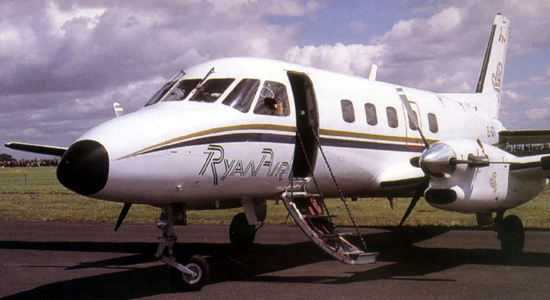
Features:Ryanair began operations on July 8, 1985 with daily flights on a 15-seater EMB 110 Embraer Bandeirante turboprop aircraft, from Waterford to London Gatwick. First cabin crew recruits must be less than 5ft. 2ins. tall in order to be able to operate in the tiny cabin of the aircraft. The 90-minute flight, Waterford's first international scheduled air service, departed at 8.30am, with the return flight departing from Gatwick at 7pm. On May 23, 1986 Rayanair launched a second route Dublin - London Luton, operated by two 46-seater BAE748 turboprop aircraft.
Interesting facts:In 1975, Irish businessman Tony Ryan founded Guinness Peat Aviation (GPA), a commercial aircraft sales and leasing company based in Shannon, Ireland. During the 1980s the company became the world's largest commercial aircraft lessor, but in early '90s economic depression undermined this commercial success, the company over-reached itself, and in 1992 it ran into debt problems. Ryan lost control of the company; however, in 1985 he had already launched a little airline, Ryanair (named after him), with co-founders Christopher "Christy" Ryan, godfather to Tony's second son Declan and worker at GPA on the sales team, and Liam Lonergan, owner of Irish travel agent Club Travel. With a share capital of just £1, and a staff of 25, they began to charter a 15-seater aircraft to bring small groups on business and leisure trips between Waterford and London Gatwick. In 1986, Ryanair obtained permission from the regulatory authorities to challenge the British Airways and Aer Lingus' high fare duopoly on the Dublin-London route; services were launched with two 46-seater aircraft. The launch fare of £99 return was less than half the price of the British Airways and Aer Lingus lowest return fare of £209. With two routes in operation, Ryanair carries 82,000 passengers in its first full year in operation. Thirty years later, in 2016, Ryanair was the largest European airline by scheduled passengers flown, and carried more international passengers than any other airline.
Ryanair getting ready to begin operations (announcement: Flight International magazine, June 22, 1985). «Ryanair starts Waterford-London link. New airline Ryanair is to launch a daily service from Waterford in south-east Ireland to London Gatwick on July 1. The carrier will operate a 15-seat Embraer Bandeirante on the route. The new service provides a welcome boost for Waterford's regional airport, which was hard hit by the collapse of Irish commuter airline Avair».
Ryanair, first aircraft operated by the company (July 8, 1985). Ryanair's first route Waterford - London Gatwick was operated by a 15-seater EMB 110 Embraer Bandeirante turboprop aircraft.
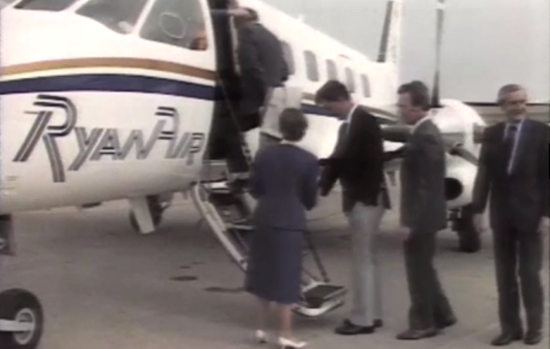
Ryanair inaugural flight - video (July 8, 1985). Click the image to see the clip (1 min.) archived by RTÉ.ie, Raidió Teilifís Éireann, Ireland's National Public Service Broadcaster.
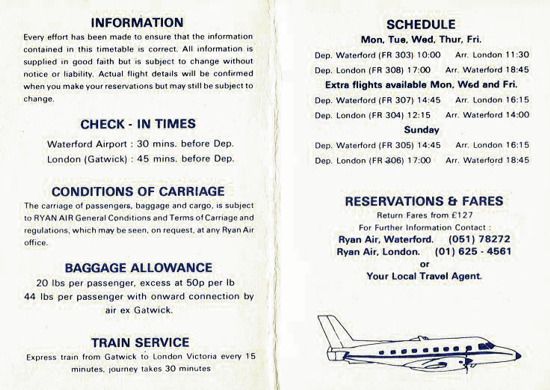
Ryanair, early timetable (January-March 1986)
Ryanair getting ready to launch the second route (announcement: Flight International magazine, May 10, 1986). «RyanAir starts Luton service. Irish carrier RyanAir begins Dublin-Luton services on May 23 using two ex-Dan-Air HS.748s. It plans to undercut the existing services of British Airways, Aer Lingus, and Dan-Air with an £86.50 no-restrictions return fare».
Ryanair, second aircraft operated by the company (May 23, 1986). Ryanair's second route Dublin - London Luton was operated by two 46-seater BAE748 turboprop aircraft, known as "The Spirit of Ireland".
Ryanair founders:Christopher "Christy" Ryan (left), Thomas Anthony "Tony" Ryan (center), and Liam Lonergan (right).
Ryanair 30th Anniversary (1985-2015). Ryanair celebrate 30 years looking back at travel with Ryanair in 1985 compared to 2015.