Adobe Photoshop


Photoshop logo 1990
Photoshop logo 1990
Project name: "Display" (1987-88)

Pre-launch names:
--- "PhotoShop" (with the 'S' capitalized, 1989)
--- "Barneyscan XP" (name for the first edition, marketed with Barneyscan scanners, 1989)

Name: "Photoshop"

Categories: Electronics, Home - Office - School

Subcategory: Raster graphics editors

Developers: Thomas and John Knoll

Producer: Adobe Systems Inc. (founded by John Warnock and Charles Geschke on February 28, 1982)

First version: 1.0 Macintosh version. Photoshop does not support Microsoft Windows until November 1992, ver. 2.5.

Licensed: September 1988

Released: February 19, 1990 - San Jose, California, USA

Platform: Macintosh

Programming language: C++, formerly Pascal

First price: 895 USD

Features: Adobe Photoshop 1.0 minumum system requirements are: Macintosh II, IIx, IIcx, IIci, SE, or SE/30; Hard disk; 2 megabytes RAM; Apple system software 6.0.2 or later. A gray-scale or color monitor is recommended, and a Macintosh compatible scanner is optional. Adobe Photoshop 1.0 editing tools are: color correction with balance, hue, and saturation; image optimization for output; curves; levels; clone tool.

Interesting facts: Photoshop was developed in 1987 by the American brothers Thomas and John Knoll, who sold the distribution license to Adobe Systems Incorporated in 1988. Thomas Knoll, a PhD student at the University of Michigan, began writing a program on his Macintosh Plus to display grayscale images on a monochrome display. This program, called "Display", caught the attention of his brother John Knoll, an Industrial Light & Magic employee, who recommended that Thomas turn it into a full-fledged image editing program. Thomas took a six-month break from his studies in 1988 to collaborate with his brother on the program. Thomas renamed the program "ImagePro", but the name was already taken. Later that year, Thomas renamed his program "PhotoShop" (with the 'S' capitalized) and worked out a short-term deal with scanner manufacturer Barneyscan to distribute copies of the program with a slide scanner; a total of about 200 copies of Photoshop were shipped this way. During this time, John traveled to Silicon Valley and gave a demonstration of the program to engineers at Apple and Russell Brown, art director at Adobe. Both showings were successful, and Adobe decided to purchase the license to distribute in September 1988. Photoshop 1.0 was released on 19 February 1990 for Macintosh exclusively. The first release was successful despite some bugs, which were fixed in subsequent updates. Most users ended up using version 1.0.7.

Property: Adobe Systems Inc.

Source Code Download: Adobe Photoshop 1.0.1 (www.computerhistory.org)

Product website: http://www.adobe.com/products/photoshop.html

Display splash screen
"Display" (Photoshop prototype) splash screen (ver. 0.07, Jan. 1988 - Not for distribution except by author). Later, Thomas Knoll renamed the program ImagePro, but the name was already taken. Someone suggested to rename it "PhotoShop", and that became the program's name.

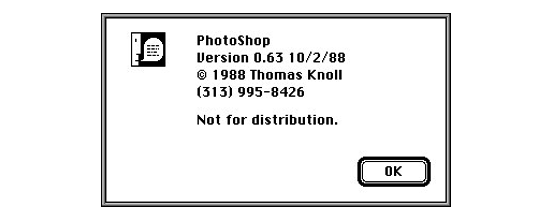
PhotoShop splash screen 1988
PhotoShop splash screen (ver. 0.63, Oct. 1988 - Not for distribution)

PhotoShop work area 1988
PhotoShop work area (ver. 0.63, Oct. 1988)

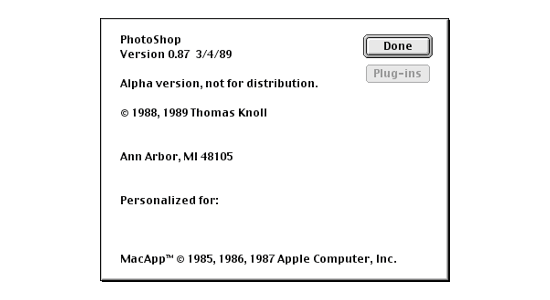
PhotoShop splash screen 1989
PhotoShop Alpha version splash screen (ver. 0.87, Mar. 1989 - Not for distribution). Thomas Knoll worked out a short-term deal with scanner manufacturer Barneyscan to distribute copies of the program - renamed "Barneyscan XP" - with a slide scanner; a total of about 200 copies of PhotoShop were shipped this way.

PhotoShop icons 1989
PhotoShop Alpha version icons (1989, design by John Knoll). The application icon was a little image of a 1 hour photo kiosk, file icons looked like rolls of 35mm film.

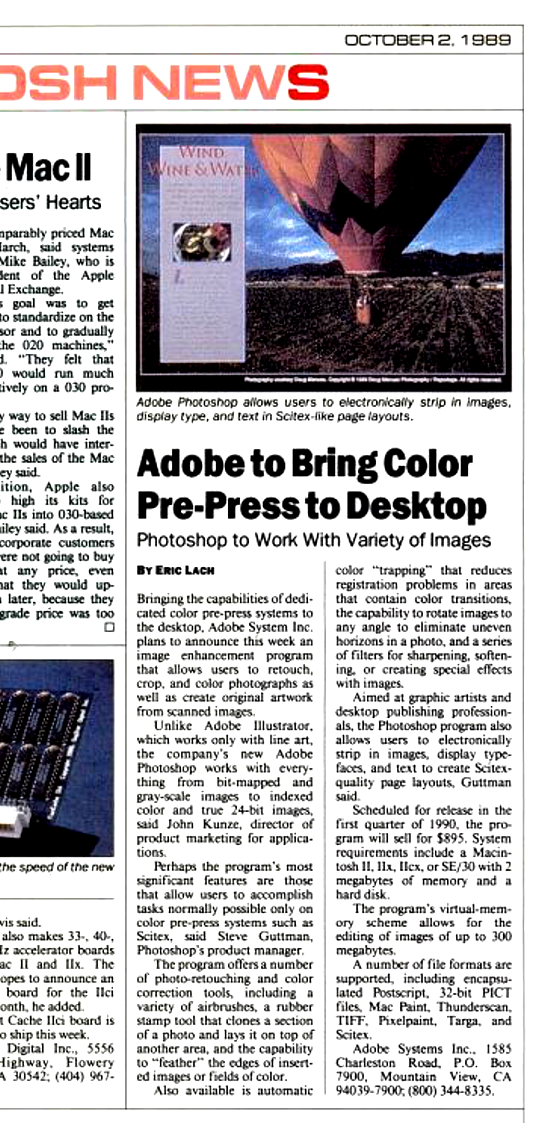
Photoshop pre-launch review 1989
Adobe Photoshop 1.0 pre-launch review (by Erich Lach, InfoWorld magazine, Oct. 2, 1989)

Photoshop package 1990
Adobe Photoshop 1.0 retail package (February 19, 1990). Package contains: the program disk; the tutorial disk, containing two sample images; a program disk containing software designed by third-party software developers; the calibration disk; Adobe Photoshop User Guide; Adobe Photoshop Tutorial; The Adobe Photoshop Quick Reference Card; Registration card and envelope.

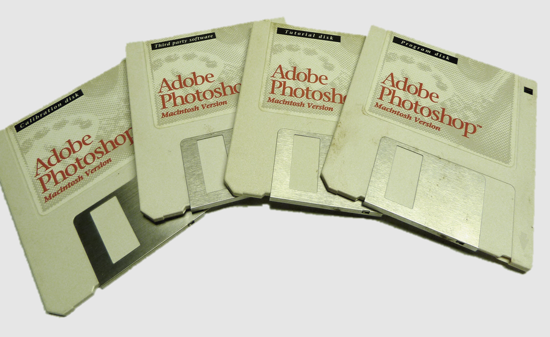
Photoshop floppy disks 1990
Adobe Photoshop 1.0 floppy disks suite. The program was deliberately constrained to 745KB so that it could fit on a single, 800KB floppy disk. The other disks contain a tutorial with two sample images, a third-party software and a calibration software.

Photoshop splash screen 1990
Adobe PhotoShop 1.0 splash screen

Photoshop icons 1990
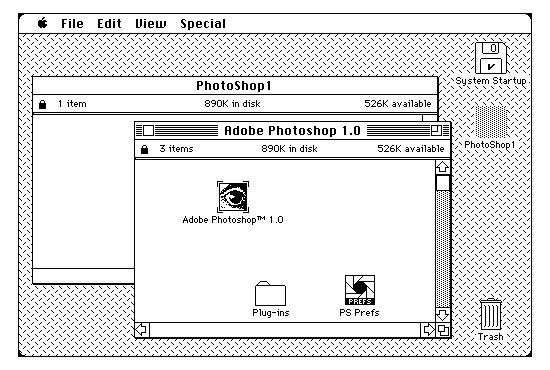
Adobe PhotoShop 1.0 icons

Photoshop work area 1990
Adobe PhotoShop 1.0 work area

Jennifer in Paradise
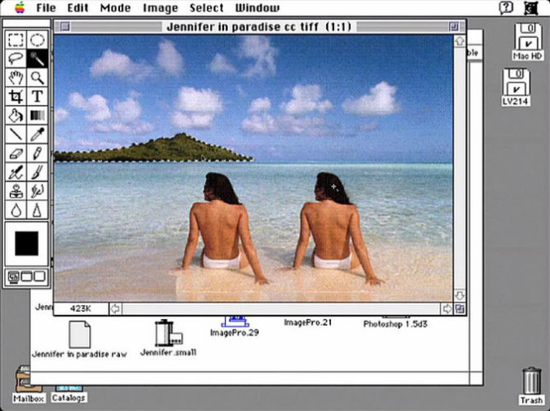
First image processed in Photoshop
"Jennifer in paradise": first ever image that was processed in Photoshop. This photo shot, taken by John Knoll of his girlfriend (then wife) Jennifer while on holiday in Fuji, was used in the early testing of the Display program, so can be said to be the first ever image to be processed in Photoshop. It was also used in early Adobe Photoshop demonstrations.

Thomas and John Knoll
Adobe Photoshop 1.0 developers: Thomas Knoll (Ann Arbor, April 14, 1960), software engineer, and his brother John Knoll (Ann Arbor, October 6, 1962), visual effects supervisor and chief creative officer (CCO) at Industrial Light & Magic.

Adobe Photoshop celebrates 25 years (official video, 2015)

Le Figaro


Le Figaro logo 1826
Le Figaro logo 1826
Name: "Le Figaro"

Category: Newspapers

Founders: Maurice Alhoy, Étienne Arago

First issue: January 15, 1826 - Paris, France

First editor: Auguste Lepoitevin Saint-Alme

First format: 4-pages folio

First price: In 1826 the subscription price to "Le Figaro" was 1 month 6 French francs, 3 months 15 Fr., 6 months 30 Fr., 1 year 60 Fr.

Overview: "Le Figaro" was named after the character in the trilogy by Pierre-Augustin Caron de Beaumarchais (Le Barbier de Séville, Le Mariage de Figaro, La Mère coupable). It is the longest French newspaper and one of the oldest in the world. Its founders were Maurice Alhoy (Paris 1802 - Apr. 27, 1856), journalist, writer and playwright, and Étienne Arago (Perpignan, Feb. 9, 1802 - Paris, Mar. 7, 1892), playwright and politician. Le Figaro, a tiny four-page journal printed on the cheapest paper, was born on January 15, 1826. In April the journal is led by Auguste Lepoitevin Saint-Alme (first contributor of Balzac and founder of Corsaire and the Corsaire-Satan); from 1827 to August 1830 by Victor Bohain (businessman, linked with Balzac too) and from 1830 to January 1834 by Henri de Latouche (another friend, author of a novel, Fragoletta). After nine years from its first edition, the original Le Figaro ceases publication: the last edition was the No. 335 published on December 1, 1834. After thirty years, the journalist Hippolyte de Villemessant relaunches Figaro as a weekly newspaper: first issue April 2, 1854. The newspaper is mostly Parisian and literary. Hippolyte de Villemessant immediately surround himself with talented writers (Balzac, Baudelaire, Alexandre Dumas and the Goncourt brothers) and innovates: it creates permanent sections in which readers find themselves, and inserts short news, obituary and letters to the editor. He also inserts the "Echoes", which made the success of the newspaper, with puns, anecdotes, indiscretions and gossip. On January 6, 1856, the newspaper becomes biweekly and then appears Wednesday and Sunday. In 1866 Le Figaro become a daily newspaper. Its first daily edition, that of November 16, 1866, sold 56,000 copies, having highest circulation of any newspaper in France.

Motto (1826): «La vérité, quand même !....» - "The truth anyway!...." (particularly challenging, because it diverts the motto «Vive le roi, quand même» - "Long live the king, anyway!")

Property: Le Figaro Group

Official website: http://www.lefigaro.fr

Le Figaro, header of the first issue 1826
Le Figaro, header of the first issue (No. 1 - January 15, 1826). Figaro is shown as it appears in the first act of Le Barbier de Séville: a smiling young man in search of inspiration, with one knee on the ground and the other as a support to write.

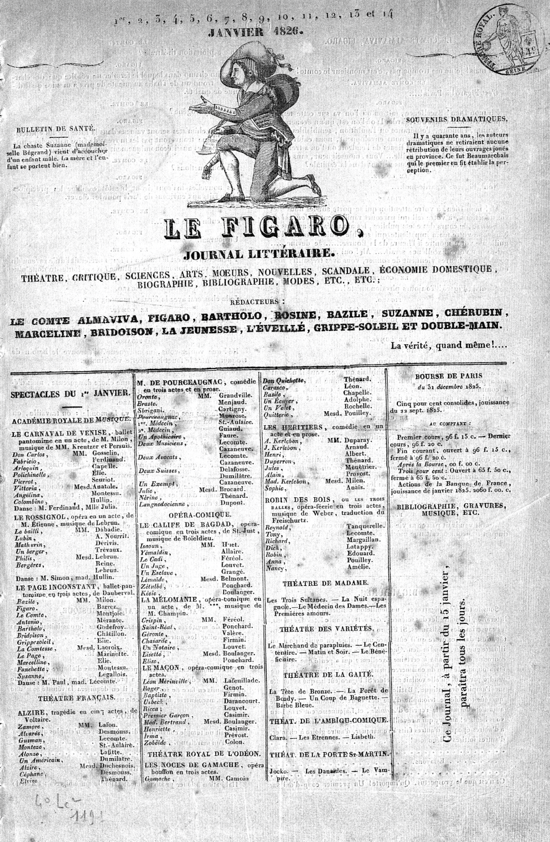
Le Figaro, front page of the first issue 1826
Le Figaro, front page of the first issue (No. 1 - January 15, 1826). Date: «1er, 2, 3, 4, 5, 6, 7, 8, 9, 10, 11, 12, 13 et 14 Janvier 1826» (a note on the bottom right warns: «Ce Journal, à partir du 15 janvier, paraitra tout les jours» - "This newspaper, from January 15, will become daily"). Title: «Le Figaro, journal littéraire. Théâtre, critique, sciences, arts, moeurs, nouvelles, scandale, économie domestique, biographie, bibliographie, modes, etc., etc.;» - "Le Figaro, literary journal. Theater, criticism, science, art, customs, news, scandals, domestic economy, biography, bibliography, fashion, etc., etc". The editors are listed as the characters in the play of Beaumarchais: «Le comte Almaviva, Figaro, Bartholo, Rosine, Bazile, Suzanne, Chérubin, Marceline, Bridoison, la Jeunesse, l'Eveillé, Grippe-Soleil et Double-Main». In December 1934 the original Le Figaro ceases publication.

Le Figaro, header of the new weekly edition 1854
Le Figaro, header of the new weekly edition (No. 1 - April 2, 1854). Below the figure, the motto «Loué par ceux-ci, blâmé par ceux-là, me moquant des sots, bravant les méchants... je me presse de rire de tout, de peur d'être obligé d'en pleurer. (Barbier de Séville)» - "Praised by them, accused by others, making fun of fools, braving the bad guys... I must force myself to laugh at everything lest I be obliged to weep. (Barber of Seville)". Below the title, «Journal non politique» - "Apolitical newspaper".

Le Figaro, front page of the new weekly edition 1854
Le Figaro, front page of the new weekly edition (No. 1 - April 2, 1854). On January 6, 1856, the newspaper becomes biweekly and then appears Wednesday and Sunday.

Le Figaro, front page of the new daily edition 1866
Le Figaro, front page of the new daily edition (No. 1 - November 16, 1866)

Hippolyte de Villemessant
Jean Hippolyte Auguste Delaunay de Villemessant (Rouen, April 22, 1810 - Monte-Carlo, April 12, 1879), the French journalist who revived Le Figaro on April 2, 1854, initially in a weekly format, than daily.

Le Figaro, front page in 2015
Le Figaro in its advanced version (January 8, 2015 - terrorist attack on the French satirical magazine Charlie Hebdo)

Queen


Queen logo
Queen logo 1973
by Freddy Mercury
Band:
--- "Smile" (1968)
--- "Queen" (1970)

First song: "Keep Yourself Alive"

Genre: Hard Rock

Musicians:
--- Freddie Mercury - lead and backing vocals
--- Brian May - guitars, backing vocals
--- John Deacon - bass guitar
--- Roger Taylor - drums, tambourine, backing vocals

Brian May
Brian Harold May
Hampton, July 19, 1947,
founder member
of the rock group Queen,
guitarist and songwriter
Writer: Brian May

DEMO VERSION
--- Recorded: December 1971
--- Producer: Louie Austin
--- Studio: De Lane Lea Studios, 75 Dean Street, Soho, London, England, UK
--- Format: The only known original source is Brian May's own 12" acetate.
--- Lenght: 3:51

RELEASE VERSION
--- Released: July 6, 1973 (UK) - October 9, 1973 (USA)
--- Producers: Queen, Roy Thomas Baker, John Anthony
--- Studio: Trident Studios, 17 St. Anne's Court, Soho, London, England, UK
--- Labels: EMI (UK) - Elektra (USA)
--- Format: Vinyl, 7", 45 rpm, A-side. On B-side: "Son And Daughter"
--- Lenght: 3:47 (UK) - 3:29 (US edit)

Overview: In 1968, guitarist Brian May, a student at London's Imperial College, and bassist Tim Staffell decided to form a band. May placed an advertisement on the college notice board for a drummer; Roger Taylor, a young dental student, auditioned and got the job. The group called themselves "Smile". While attending Ealing Art College, Tim Staffell became friends with Farrokh Bulsara, a fellow student who had assumed the English name of Freddie. Bulsara felt that he and the band had the same tastes and soon became a keen fan of Smile. In late 1970, after Staffell left to join the band Humpy Bong, the remaining Smile members, encouraged by Bulsara, changed their name to "Queen" and continued working together. The band had a number of bass players, until February 1971 that they settled on John Deacon. Around this time Freddie changed his surname to "Mercury". On July 2, 1971, Queen played their first show in the classic line-up of Mercury, May, Deacon and Taylor at a Surrey college outside London.
"Keep Yourself Alive" is the first of five demos recorded by the band in December 1971 at the new De Lane Lea Studios, London, England. The sessions are arranged through contacts at the studio who agree to let the band record in exchange for the band testing the equipment and facilities for engineers. Tracks worked on are: "Keep Yourself Alive", "The Night Comes Down", "Great King Rat", "Jesus", "Liar". The De Lane Lea Demo of "Keep Yourself Alive" begins with the needle hitting the acetate; giving it an authentic and special feel. The intro is played on Brian May's Hairfred acoustic guitar, before the Red Special takes over. The fade-out ending is similar to the album version.

Quote (Brian May): «The first recording of "Keep Yourself Alive" ever was in De Lane Lea when we did it ourselves and I've still got that recording and I think it’s very good and has something which the single never had. But they pressurised us very strongly to redo all the tracks and we redid "Keep Yourself Alive" with Roy and it was pretty awful, actually. I thought it was terrible and I was very unhappy about it and I thought the De Lane Lea one was better and I eventually managed to persuade Roy that it was better as well. So, we went back in and did it again in a way that was a bit more true to the original. But there is no way that you can ever really repeat something. I have this great belief that the magic of the moment can never be recaptured and, although we ended up with something that was technically in the playing and perhaps even in the recording a bit better than the De Lane Lea thing. I still think that the De Lane Lea one had that certain sort of magic, so I was never really happy. As it turned out no one else was ever really happy either and we kept remixing it. We thought that it's the mix that's wrong, we kept remixing and there must have been, at least, seven or eight different mixes by different groups of people. Eventually we went in and did a mix with Mike Stone, our engineer, and that's the one that we were in the end happiest with. That’s the one we put out».

Property: EMI Records Ltd. - Elektra Records

Official website: http://www.queenonline.com

Flyer: Queen concert 1971
Flyer: before recording the demo, Queen performs "Keep Yourself Alive" on January 9, 1971 at Ewell Technical College, Ewell, Surrey, England, supporting Kevin Ayers And The Whole World. Bass player at this time: Barry Mitchell.


"Keep Yourself Alive" original audio (De Lane Lea Demo Version, Dec. 1971)
KEEP YOURSELF ALIVE

I was told a million times of all the people in my way
And how I have to keep on trying just get better every day
But if I crossed a million rivers, and I rode a million miles
Then I'd still be where I started, bread and butter for a smile
Well, I sold a million mirrors in a shop in alley way
But I never saw my face in any window any day
Now they say your folks are telling you to be a superstar
But I tell you just be satisfied and stay right where you are

Keep yourself alive, yeah, keep yourself alive
All you people keep yourself alive

Well I loved a million women in a belladonic haze
And I ate a million dinners brought to me on silver trays
Give me everything I need to feed my body and my soul
And I'll grow a little bigger, then that can be my goal
I was told a million times of all the troubles in my way
How I had to keep on trying and get better every day
But if I crossed a million rivers, and I rode a million miles
Then I'd still be where I started, same as when I'd started

Keep yourself alive, yeah, keep yourself alive
Take you all your time and money
Honey you'll survive

Wooh-hoo

Oh

Keep yourself alive, keep yourself alive, oh
Take you all your time and money
To keep me satisfied

Do you think you're better every day
No, I just think I'm two steps nearer to my grave, yeah

Keep yourself alive, come on, keep yourself alive
All you people keep yourself alive
Keep yourself alive, yes you've gotta keep yourself alive
All you pretty people keep yourself alive
Keep yourself alive, ooh, keep yourself alive
All you people keep yourself alive
Keep yourself alive, yes, yes, yes
Keep yourself alive
All you people keep yourself alive
"Keep Yourself Alive" lyrics (De Lane Lea Demo Version, Dec. 1971)

First Queen single 1973
"Keep Yourself Alive" release version on single vinyl A-side (EMI, July 6, 1973). On B-side the song "Son And Daughter".

"Keep Yourself Alive" official video

Queen in 1973
Queen in 1973. From left: Roger Taylor, Freddy Mercury, Brian May, John Deacon.

Alice in Wonderland (film)


Alice in Wonderland film title
Alice in Wonderland
(1903) film title frame
Title: "Alice in Wonderland"

Category: Movies

Subcategory: Fantasy

Directors: Cecil M. Hepworth, Percy Stow

Writers: Lewis Carroll (novel), Cecil M. Hepworth

Based on: Lewis Carroll's children's book
"Alice's Adventures in Wonderland" (1865)

Cecil Hepworth
Cecil Milton Hepworth
Lambeth, Mar. 19, 1874 -
Greenford, Feb. 9, 1953,
writer of the 1903 film
Alice in Wonderland,
director with Percy Stow,
also plays the Frog.
Starring:
--- May Clark (Alice)
--- Cecil M. Hepworth (Frog)
--- Mrs. Cecil Hepworth (White Rabbit / Queen)
--- Norman Whitten (Fish / Mad Hatter)
--- Geoffrey Faithfull (Card)
--- Stanley Faithfull (Card)
--- Blair (Dog)

Producer: Hepworth Film Manufacturing Company

Executive producers: Herman Casler, Elias Koopman, Harry Marvin

Cinematography: Cecil M. Hepworth, Liwayway Memije-Cruz

Distributors: Hepworth Film Manufacturing Company (UK) - American Mutoscope and Biograph Company, Edison Manufacturing Company (USA)

Released: May 1903 (Surrey, England, UK) - October 17, 1903 (USA)

Running time: 8 min. 19 sec. (originally 12 min.)

Color: B/W

Language: Silent

Summary plot: Alice follows the White Rabbit down a mysterious hole and finds herself in a strange new world. Text from the original silent film titles:
1) "Alice dreams that she sees the White Rabbit and follows him down the Rabbit-hole, into the Hall of Many Doors".
2) "Alice, now very small, has gained access to the Garden where she meets a Dog and tries to make him play with her".
3) "Alice enters the White Rabbit's tiny House, but, having suddenly resumed her normal size, she is unable to get out until she remembers the magic fan".
4) "The Duchess's Cheshire Cat appears to Alice and directs her to the Mad Hatter. - The Mad Tea-Party".
5) "THE ROYAL PROCESSION - The Queen invites Alice to join. - Alice unintentionally offends the Queen who calls the Executioner to behead her. But Alice, growing bolder, boxes his ears and in the confusion which results, she awakes".

Interesting facts: The 1903 British silent film "Alice in Wonderland" was the first movie adaptation of Lewis Carroll's children's book "Alice's Adventures in Wonderland". It also was the longest film yet produced in Britain, running about 12 minutes. In 1903, there were two directors working at the Hepworth studio in Walton-on-Thames, Cecil Hepworth and Percy Stow. Hepworth was responsible for the studio's non-fiction films, while Stow made all the fiction films. This was such a large production that the two men worked together. The film was made on the small wooden stage in the garden of the villa housing Hepworth's company, with exteriors shot in the lavish gardens of Mount Felix, a local estate which until recently had been owned by the son of Thomas Cook the travel agent. Alice was played by Mabel Clark, Hepworth played the frog footman and his wife played the White Rabbit and the Queen. Only one copy of the original film is known to exist and parts are now lost. The British Film Institute partially restored the movie and its original film tinting and released it in 2010.

Property: Hepworth


Alice in Wonderland - screenshot 1
Alice in Wonderland - screenshot 2
Alice in Wonderland - screenshot 3
Alice in Wonderland (1903), screenshots from the movie

Alice in Wonderland (1903), complete film ready to play (8 min. 19 sec.)

Honda (motorcycles): 1st model ever


Honda logo 1947
Honda Motor logo 1947
Name: Honda "A-Type"

Nickname: "Bata Bata"

Category: Motorcycles

Subcategory: Motor-bicycles

Inventor: Soichiro Honda

Producer: Honda Motor Company

Prototype made in: October 1946

Production start: November 1947 - Hamamatsu, Japan

Prototype features: The Honda "A-Type" prototype was a motorized bicycle which used a tubular fuel tank that had been nicknamed the "tea canister"; it was equipped with an auxiliary engine made from a small, remodeled unit that had served as a power generator for an old no. 6 military radio transmitter. This engine marked the origin of Honda Motor.

First model features: The Honda "A-Type" had a cast aluminum fuel tank with a teardrop shape made by sand casting. Engine Air-Cooled 2-st. Single Rotary Valv. 50cc. Maximum power 1PS / 5,000rpm. Maximum speed: 45km/h. Dry weight: 10kg. Cantilever crankshaft, v-belt clutch, variable transmission.

Interesting facts: Throughout his life, Honda's founder, Soichiro Honda had an interest in automobiles. In 1937, Honda founded Tōkai Seiki to produce piston rings for Toyota. During World War II, a US B-29 bomber attack destroyed Tōkai Seiki's Yamashita plant in 1944 and the Itawa plant collapsed in the 1945 Mikawa earthquake. In 1946 Japan is struggling to regain some semblance of normalcy, after having been bombed flat at the end of WWII. Soichiro Honda realizes the need for affordable transportation and begins grafting war-surplus two-stroke motors onto bicycles (the motors had originally been intended for use on portable generators for military radios). In October 1946, he established the Honda Technical Research Institute in Hamamatsu, Japan, to develop and produce small 2-cycle motorbike engines. In November 1947, Soichiro Honda started producing a complete motorized bicycle, the "A-Type" (nicknamed "Bata Bata" for the sound the engine made), which was driven by the first mass-produced engine designed by Honda, and was sold until 1951. The first complete motorcycle was the 1949 D-Type, also known as the Honda Dream.

Quote (Soichiro Honda): «Success represents the 1% of your work which results from the 99% that is called failure».

Property: Honda Motor Co., Ltd.

Producer website: http://world.honda.com

Honda Type-A prototype - left
Honda Type-A prototype - front
Honda Type-A prototype - front detail
Honda Type-A prototype - right
Honda Type-A prototype - right detail
Honda A-Type prototype (October 1946). Its engine marked the origin of Honda Motor.

Honda Type-A left
Honda Type-A right
Honda A-Type (November 1947). Honda's first product on the market.

Honda factory in 1948
Honda A-Type, engine assembly at the Noguchi Plant (1948)

Honda Hamamatsu factory 1948
Honda A-Type, employees and their families at the Hamamatsu factory (1948)

Honda Type-D (right)
Honda Type-D
Honda Type-D (engine)
Honda Type-D (left)
Honda D-Type (August 1949). Also known as the Honda Dream, the first complete motorcycle manufactured by Honda featured a two-stroke, 98cc, single-cylinder engine, and 3 horsepower.

Soichiro Honda
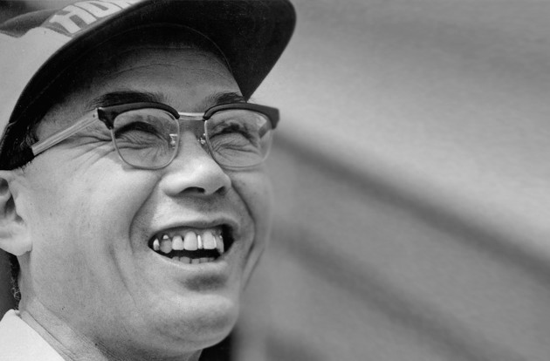
Soichiro Honda (Hamamatsu, Nov. 17, 1906 - Tokyo, Aug. 5, 1991), the Japanese engineer and industrialist who invented the Honda A-Type and founded the Honda Motor Company.

Honda 2015
Honda motorcycles, an advanced model (CBR1000RR, 2015)

Honda Motor 75th Anniversary
Honda Motor Company celebrates its 75th Anniversary (1948-2023)