Yomiuri Shimbun


Yomiuri Shimbun logo
Name: "Yomiuri Shimbun"

Category: Newspapers

Founders:
--- Takashi Koyasu
--- Morimichi Motono
--- Shôkichi Shibata

First issue: November 2, 1874 - Toranomon, Minato, Tokyo, Japan

First editor: Takashi Koyasu

Takashi Koyasu
Takashi Koyasu (1836-1898), Industrialist, founder of Nisshusha company in 1870 (changed to The Yomiuri Shimbun since December 1, 1917) and founder of the Yomiuri Shimbun newspaper in 1874 with co-founders Morimichi Motono and Shôkichi Shibata.
Overview: In 1870 Japanese Industrialist Takashi Koyasu established the letterpress printing company "Nisshusha" in Yokohama, with the former First Secretary of Foreign Affairs Morimichi Motono and the interpreter Shokichi Shibata, and published an English-Japanese dictionary.
In 1874 they launched the "Yomiuri Shimbun" in Toranomon, Minato, Tokyo: the name literally means "sell by reading newspaper", and refers to the newspaper sellers of Edo period (1603-1868). Yomiuri Shimbun was one of five new dailies created early in the Meiji period (1868–1912) to meet the need for a vernacular newspaper in the rapidly modernizing society of Japan. It became popular among the general public for its easy-to-read style, and in the following year its circulation had grown from 200 every other day to more than 10,000; by 1877 it had exceeded 33,400. In the beginning, the Yomiuri Shimbun published literature, novel translations, and some famous writers such as Kôyô Ozaki. In 1914 the Yomiuri Shimbun creates "Yomiuri Fujin Furoku", a page dedicated to articles for women, the first in Japanese newspapers. On September 1, 1923, the new Yomiuri Shimbun's head office building, located at Ginza 3-chome, was destroyed in Great Kanto Earthquake; in 1945, just before the end of World War II, an air raid burnt down headquarters building a second time; but Yomiuri Shimbun flourished again by building a strong national sales network.

Property: The Yomiuri Shimbun - Yomiuri Group

Official website: http://www.yomiuri.co.jp

Yomiuri Shimbun first issue 1874 - front
Yomiuri Shimbun first issue 1874 - back
Yomiuri Shimbun first issue front back (November 2, 1874)

Yomiuri Shimbun, first photo 1888
Yomiuri Shimbun was the first Japanese newspaper to carry a news photo (August 7, 1888). The image, printed using asphalt copperplate, shows the lake Inawashito immediately after the eruption of Mt. Bandai, Fukushima Prefecture.

Yomiuri Shimbun, Konjiki Yasha 1897
Yomiuri Shimbun begins serialization of Ozaki Kôyô's novel "Konjiki Yasha" - The Golden Demon (January 1, 1897)

Yomiuri Shimbun issue 10,000 - April 8, 1905
Yomiuri Shimbun issue No. 10,000 (April 8, 1905)

Yomiuri Fujin Furoku, 1914
Yomiuri Shimbun was the first Japanese newspaper to introduce pages devoted to women's interests (April 3, 1914). Originally called "Yomiuri Fujin Furoku", these pages evolved into a Lifestyle section.

Yomiuri Shimbun Building and issue No. 50,000
Left: Yomiuri Shimbun celebrate their 140th anniversary (1874-2014) starting operations from the Yomiuri Shimbun Building, their new headquarters in Tokyo's central Otemachi district. Right: Yomiuri Shimbun issue No. 50,000 (April 9, 2015).
In 2010, in the Britain's Guinness Book of World Records, the Yomiuri Shimbun was credited with having the highest circulation in the world, and with being the only newspaper to have a morning circulation in excess of 10 million copies: the morning edition had a circulation of 10,020,584, while the evening edition had a circulation of 3,516,692, producing a combined figure of 13,537,276; with an average of 2.5 readers per copy, this results in a total readership of 25,051,460 per day.

The Times of India


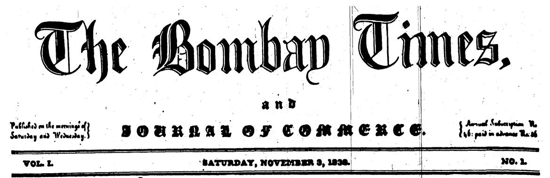
The Times of India first issue's header
The Times of India, first header: "The Bombay Times and Journal of Commerce"
(Saturday, November 3, 1838)

Names:
--- "The Bombay Times and Journal of Commerce" (November 3, 1838)
--- "Bombay Times and Standard" (1860-1861)
--- "The Times of India" (since September 28, 1861)

Category: Newspapers

Founder: Raobahadur Narayan Dinanath Velkar

First issue: November 3, 1838 - Mumbai (then Bombay), Maharashtra, India

First editor: J.E. Brennan

First format: Broadsheet

First price: 1 year = 30 Rupees

Overview: Originally called "The Bombay Times and Journal of Commerce", the paper was founded in 1838 in Mumbai (then Bombay), during the British Raj, to serve the British residents of western India, following Lord Metcalfe's Act of 1835 which removed restrictions on the liberty of the Indian press. Its first editor J.E. Brennan, a retired Irish doctor, was also secretary of the Bombay Chamber of Commerce. In the first issue, he wrote on the need of education for the people of India "whose capacity for improvement is inferior to that of no one elsewhere but were victims of ignorance and delusion". At first, the paper published twice weekly, Wednesdays and Saturdays, under the direction of Raobahadur Narayan Dinanath Velkar, a Maharashtrian Reformist, and contained news from Britain and the world. In 1840, the newspaper changes hands and George Buist becomes the editor. The paper became a daily in 1850.
Robert Knight
Robert Knight (1825 - 1892),
the editor who reinvented
the newspaper under the name
"The Times of India" (1861)
In 1859, new editor Robert Knight merged "The Bombay Times and Journal of Commerce" with two more popular newspapers – "Bombay Standard" and "Chronicle of Western India", and founded "Bombay Times and Standard".
Two years later, on Sept. 28, 1861, Knight merged "Bombay Times and Standard" with "Bombay Telegraph & Courier", and renamed "The Bombay Times and Standard" to "The Times of India".
Knight fought for a press free of prior restraint or intimidation, frequently resisting the attempts by governments, business interests, and cultural spokesmen and led the paper to national prominence.
In 1880, The Times of India Weekly Edition was launched.
In 1890, the newspaper printed 3,000 copies daily.
The Times of India saw its ownership change several times until 1892, when Thomas Bennett and Frank Morris Coleman acquired the newspaper through their new company: Bennett, Coleman & Co. Ltd.

Property: The Times Group - Bennett Coleman & Co. Ltd

Official website: https://timesofindia.indiatimes.com


The Times of India, first issue 1838
The Times of India, front page of the first issue (November 3, 1838). The front page is taken up solely by classified advertisements, a practice that continues up to 1939.

The Times of India, machine room in 1898
The Times of India, binding room in 1898
The Times of India, 60th Anniversary, November 1898
The Times of India, employees at Mumbai during the newspaper's Diamond Jubilee (60th Anniversary, November 1898)

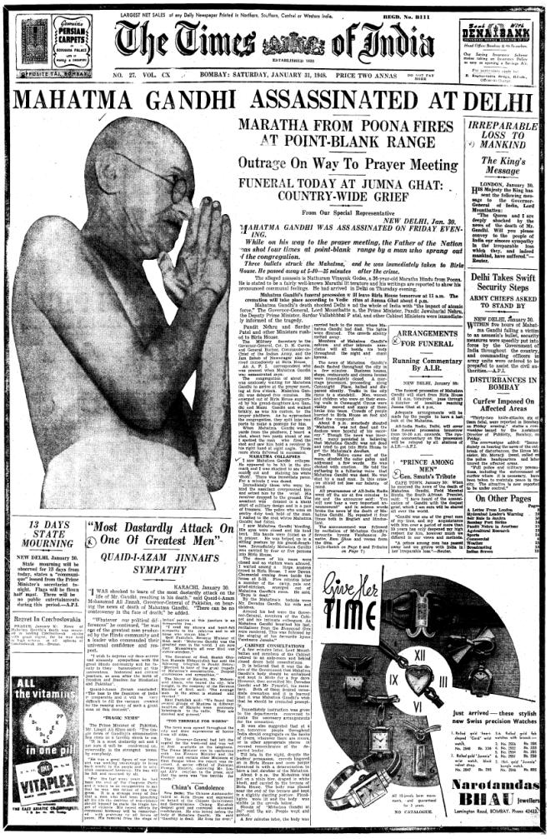
The Times of India, January 31, 1948
The Times of India, when India lost the father of the nation (January 31, 1948)

The Times of India, a commemorative stamp marks its 175th anniversary in 2013
The Times of India, 175th anniversary, November 2013
The Times of India, commemorative stamp featuring "Common Man" - a character by cartoonist R.K. Laxman, issued by Indian Post to mark 175 years (November 13, 2013)

The Times of India, June 25, 2016
The Times of India in its advanced version (June 25, 2016 - Brexit)

Corriere della Sera


Corriere della Sera first issue's header
Corriere della Sera, first issue's header (March 5-6, 1876)

Eugenio Torelli Viollier
(Naples, Mar. 26, 1842 - Apr. 26, 1900),
Italian journalist and politician,
creator of the Corriere della Sera
and co-founder with Riccardo Pavesi

Name: "Corriere della Sera"

Category: Newspapers

Founders:
--- Eugenio Torelli Viollier
--- Riccardo Pavesi

First issue: March 5, 1876 - Milan, Italy

First editor: Riccardo Pavesi

First format: Broadsheet

First price: 5 centesimi (7 outside Milan, 10 for back issue) ITL

Overview: First published on March 5, 1876, Corriere della Sera (Italian for Evening Courier) is one of Italy's oldest daily newspapers. The foliation was four pages, printed in 15,000 copies. The newspaper was published with a double dating (March 5-6, for example), because due to the slowness of transport often copies arrived in the other regions the next day. The double dating would last until December 1902. In 1899 Corriere della Sera began to offer some interesting periodical supplements:
Corriere della Sera 1866
A newspaper "Corriere della Sera"
was founded by Giuseppe Rovelli
in Turin in 1866, ten years before
the newspaper founded in Milan,
but after only two issues (August 1-2)
it ceased publication for lack of funds
• La Domenica del Corriere (The Sunday Courier, popular, illustrated, Jan. 8, 1899);
• La Lettura (The Reading, addressed to the educated public, Jan. 1901);
• Romanzo mensile (Novel monthly, which collects the serial novels published in the Courier, Apr. 1903);
• Corriere dei Piccoli (Courier of the Childrens, Dec. 27, 1908: it was the first Italian periodical to make a regular feature of publishing comic strips).
In the 1910s and 1920s, under the direction of Luigi Albertini (1871-1941), Corriere della Sera became the most widely read newspaper in Italy, maintaining its importance and influence into the present century. In 2001, 125th anniversary of the birth of the Courier, was created the "Fondazione Corriere della Sera", a foundation with the aim of curing and open to the public the historical archives of the newspaper, and to promote initiatives in favor of the language and Italian culture.

Property: RCS MediaGroup S.p.A.

Official website: http://www.corriere.it

Corriere della Sera, first issue - zoom
The Daily Universal Register, first issue
Corriere della Sera, front page of the first issue (March 5-6, 1876)

Corriere della Sera, advertising 1898
Corriere della Sera advertising poster (1898, by Adolfo Hohenstein)

Domenica del Corriere, first issue 1899
La Domenica del Corriere, Sunday supplement by Corriere della Sera (Jan. 8, 1899)

Corriere dei Piccoli, first issue 1908
Corriere dei Piccoli, weekly for children by Corriere della Sera (Dec. 27, 1908)

Corriere della Sera 1946
Corriere della Sera, front page June 6, 1946: Italy became a republic (June 2)

Corriere della Sera 2013
Corriere della Sera in its advanced version (March 14, 2013 - Election of Pope Francis)

Corriere della Sera - 150th Anniversary - March 5, 1876-2026
Corriere della Sera celebrates its 150 years (March 5, 1876-2026). President Mattarella attended the event "Corriere 150 Years. Freedom of Ideas" at the "Teatro alla Scala", Milan.

El País


El País logo 1976
El País logo 1976
Name: "El País"

Category: Newspapers

Founders:
--- José Ortega Spottorno
--- Jesús de Polanco
--- Juan Luis Cebrián

First issue: May 4, 1976 - Madrid, Spain

First editor: Ediciones El País, S.L. - Promotora de Informaciones, S.A (PRISA)

First format: Tabloid

First price: 10 pesetas

Overview: El País, based in Madrid, is a daily newspaper owned by the Spanish media conglomerate PRISA. The appearance of El País is characterized by its sobriety, in both its treatment of information and its esthetics. The newspaper was designed by Reinhard Gade and Julio Alonso; it has had the same design from its foundation until October 21, 2007, with hardly any changes: it used only black-and-white photographs, and the same Times Roman font. The paper's ideology has always been defined by a leaning towards Europeanism.
El País was first published on 4 May 1976, six months after the death of dictator Francisco Franco, and at the beginning of the Spanish transition to democracy. The first editor-in-chief of the daily was Juan Luis Cebrián. El País was the first pro-democracy newspaper within a context where all the other Spanish newspapers were influenced by Franco's ideology. The circulation of the paper was 116,600 copies in its first year. In 1983 El País was awarded the Prince of Asturias Award for Communication and the Humanities. The 2008 circulation of El País was 435,083 copies, making it the most read daily in the country.

Motto (until Oct. 21, 2007): «Diario independiente de la mañana» - "Independent morning daily"

Property: Ediciones El País, S.L. - PRISA

Official website: http://www.elpais.com

El País, front page of the first issue 1976
El País, front page of the first issue (May 4, 1976)

El País, front page July 4, 1976
El País, front page of the issue dedicated to Adolfo Suárez, Spain's first democratically elected Prime Minister since the Second Spanish Republic and a key figure in the country's transition to democracy after the death of authoritarian leader Francisco Franco (July 4, 1976)

The founders of El País
The founders of El País. From left: José Ortega Spottorno (Nov. 13, 1918 - Feb. 18, 2002), journalist and publisher; Jesús de Polanco (Nov. 7, 1929 - July 21, 2007), businessman; Juan Luis Cebrián (Oct. 30, 1944), writer and journalist, first editor-in-chief of El País.

El País 50th Anniversary - 1976-2026
El País celebrates its 50th Anniversary (1976-2026)

Le Figaro


Le Figaro logo 1826
Le Figaro logo 1826
Name: "Le Figaro"

Category: Newspapers

Founders: Maurice Alhoy, Étienne Arago

First issue: January 15, 1826 - Paris, France

First editor: Auguste Lepoitevin Saint-Alme

First format: 4-pages folio

First price: In 1826 the subscription price to "Le Figaro" was 1 month 6 French francs, 3 months 15 Fr., 6 months 30 Fr., 1 year 60 Fr.

Overview: "Le Figaro" was named after the character in the trilogy by Pierre-Augustin Caron de Beaumarchais (Le Barbier de Séville, Le Mariage de Figaro, La Mère coupable). It is the longest French newspaper and one of the oldest in the world. Its founders were Maurice Alhoy (Paris 1802 - Apr. 27, 1856), journalist, writer and playwright, and Étienne Arago (Perpignan, Feb. 9, 1802 - Paris, Mar. 7, 1892), playwright and politician. Le Figaro, a tiny four-page journal printed on the cheapest paper, was born on January 15, 1826. In April the journal is led by Auguste Lepoitevin Saint-Alme (first contributor of Balzac and founder of Corsaire and the Corsaire-Satan); from 1827 to August 1830 by Victor Bohain (businessman, linked with Balzac too) and from 1830 to January 1834 by Henri de Latouche (another friend, author of a novel, Fragoletta). After nine years from its first edition, the original Le Figaro ceases publication: the last edition was the No. 335 published on December 1, 1834. After thirty years, the journalist Hippolyte de Villemessant relaunches Figaro as a weekly newspaper: first issue April 2, 1854. The newspaper is mostly Parisian and literary. Hippolyte de Villemessant immediately surround himself with talented writers (Balzac, Baudelaire, Alexandre Dumas and the Goncourt brothers) and innovates: it creates permanent sections in which readers find themselves, and inserts short news, obituary and letters to the editor. He also inserts the "Echoes", which made the success of the newspaper, with puns, anecdotes, indiscretions and gossip. On January 6, 1856, the newspaper becomes biweekly and then appears Wednesday and Sunday. In 1866 Le Figaro become a daily newspaper. Its first daily edition, that of November 16, 1866, sold 56,000 copies, having highest circulation of any newspaper in France.

Motto (1826): «La vérité, quand même !....» - "The truth anyway!...." (particularly challenging, because it diverts the motto «Vive le roi, quand même» - "Long live the king, anyway!")

Property: Le Figaro Group

Official website: http://www.lefigaro.fr

Le Figaro, header of the first issue 1826
Le Figaro, header of the first issue (No. 1 - January 15, 1826). Figaro is shown as it appears in the first act of Le Barbier de Séville: a smiling young man in search of inspiration, with one knee on the ground and the other as a support to write.

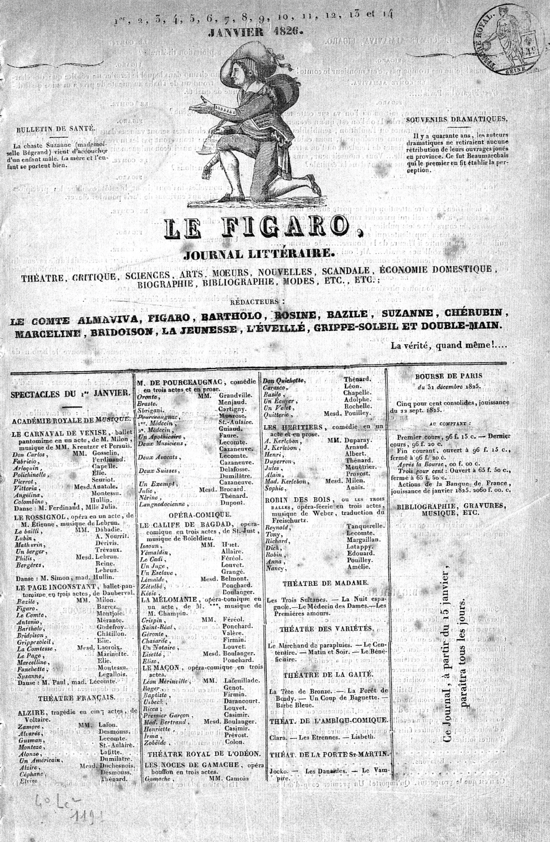
Le Figaro, front page of the first issue 1826
Le Figaro, front page of the first issue (No. 1 - January 15, 1826). Date: «1er, 2, 3, 4, 5, 6, 7, 8, 9, 10, 11, 12, 13 et 14 Janvier 1826» (a note on the bottom right warns: «Ce Journal, à partir du 15 janvier, paraitra tout les jours» - "This newspaper, from January 15, will become daily"). Title: «Le Figaro, journal littéraire. Théâtre, critique, sciences, arts, moeurs, nouvelles, scandale, économie domestique, biographie, bibliographie, modes, etc., etc.;» - "Le Figaro, literary journal. Theater, criticism, science, art, customs, news, scandals, domestic economy, biography, bibliography, fashion, etc., etc". The editors are listed as the characters in the play of Beaumarchais: «Le comte Almaviva, Figaro, Bartholo, Rosine, Bazile, Suzanne, Chérubin, Marceline, Bridoison, la Jeunesse, l'Eveillé, Grippe-Soleil et Double-Main». In December 1934 the original Le Figaro ceases publication.

Le Figaro, header of the new weekly edition 1854
Le Figaro, header of the new weekly edition (No. 1 - April 2, 1854). Below the figure, the motto «Loué par ceux-ci, blâmé par ceux-là, me moquant des sots, bravant les méchants... je me presse de rire de tout, de peur d'être obligé d'en pleurer. (Barbier de Séville)» - "Praised by them, accused by others, making fun of fools, braving the bad guys... I must force myself to laugh at everything lest I be obliged to weep. (Barber of Seville)". Below the title, «Journal non politique» - "Apolitical newspaper".

Le Figaro, front page of the new weekly edition 1854
Le Figaro, front page of the new weekly edition (No. 1 - April 2, 1854). On January 6, 1856, the newspaper becomes biweekly and then appears Wednesday and Sunday.

Le Figaro, front page of the new daily edition 1866
Le Figaro, front page of the new daily edition (No. 1 - November 16, 1866)

Hippolyte de Villemessant
Jean Hippolyte Auguste Delaunay de Villemessant (Rouen, April 22, 1810 - Monte-Carlo, April 12, 1879), the French journalist who revived Le Figaro on April 2, 1854, initially in a weekly format, than daily.

Le Figaro 200th Anniversary - January 15, 1826-2026
Le Figaro celebrates its 200th Anniversary (January 15, 1826-2026)

The Times


The Times first issue's header
The Times, first issue header: The Daily Universal Register (January 1, 1785)

Names:
--- "The Daily Universal Register" (January 1, 1785)
--- "The Times" (since January 1, 1788)

Category: Newspapers

Founder: John Walter

First issue: January 1, 1785 - London, UK

First editor: John Walter

First format: Broadsheet

First price: Two-pence halfpenny

Overview: The Times was founded by publisher John Walter on January 1, 1785 as The Daily Universal Register, with Walter in the role of editor. John Walter bought the logography's patent and, in order to use it, he decided to open a printing house, where he would daily produce an advertising sheet. In 1788, John Walter decided to change the title to "The Times" (January 1) and the style of his newspaper. Walter now started to produce a newspaper that appealed to a larger audience. This included stories of the latest scandals and gossip about famous people in London. One of these stories about the Prince of Wales resulted in Walter being fined £50 and sentenced to two years in Newgate Prison. The founder's son, John Walter II, took over the newspaper in 1803. He expanded it from 4 pages to 12 large pages, and, by the time control of the paper passed to his son, John Walter III, in 1848, the foundations of The Times's reputation as Britain's preeminent national journal and daily historical record had been laid. The Times is the originator of the widely used Times Roman typeface, originally developed by Stanley Morison of The Times in collaboration with the Monotype Corporation for its legibility in low-tech printing.

Property: News UK

Official website: http://www.thetimes.co.uk

The Daily Universal Register, first issue - zoom
The Daily Universal Register, first issue
The Times, first issue: The Daily Universal Register (January 1, 1785)

The Times, header in 1787
The Times, header of The Daily Universal Register in 1787 (August 29)

The Times logo 1788
The Times, first issue - zoom
The Times, first issue
The Times, first issue with its distinctive name (January 1, 1788)

The Times, header December 1788
The Times, header in late 1788 (December 4)

John Walter and son
John Walter (London, 1739 - November 17, 1812), publisher and founder of The Times newspaper, and his son of the same name (London, February 23, 1776 - July 28, 1847), second editor 1803 - 1812.

The Times, Sep. 19, 2014
The Times in its advanced version (September 19, 2014 - voters in Scotland rejected independence in a historic referendum that threatened to break apart the United Kingdom)