Palmolive (soap)


Palmolive logo 1899
Palmolive logo 1899
Name: "Palmolive"

Category: Health - Beauty

Subcategory: Soap

Inventor - Producer: B. J. Johnson Soap Co. (founded by Burdett J. Johnson in 1864, Milwaukee, Wisconsin, USA, as B. J. Johnson & Company, renamed B. J. Johnson Soap Company in 1894, then The Palmolive Company in 1917, under the management of Burdett's son Caleb Elliott Johnson)

Production start: 1898 - Milwaukee, Wisconsin, USA

First price: 10 cents a cake

Features: The original formula of Palmolive Soap was composed primarily of palm oil, olive oil, and cocoa butter.

Interesting facts: In 1864 Burdett J. Johnson, native from New York, estabilished the B. J. Johnson & Company, a soap manufacturing business in Milwaukee, Wisconsin. A few years later Burdett's son Caleb Elliott Johnson entered the father's business: initially as a worker, then as a traveling salesman and regular employee of the company. On December 31, 1894, the company was renamed B. J. Johnson Soap Company, and Caleb Johnson was made vice president until 1902, when his father died and he succeeded the presidency. During these years - exactly in 1898, the company introduced the Palmolive Soap, so called after its formula that included palm and olive oils. In 1917 the corporation was renamed The Palmolive Company, having a run of success over the years – relying heavily on advertising: the product proved wildly popular, thanks in large part to an advertising campaign that promoted it as an exotic cleanser that would have been favored in the age of the Pharaohs. By the early 1900s, Palmolive was the world's best-selling soap and a full line of Palmolive cosmetics soon followed; in 1928, the company merged with Colgate and the resulting firm, Colgate-Palmolive, still exists today.

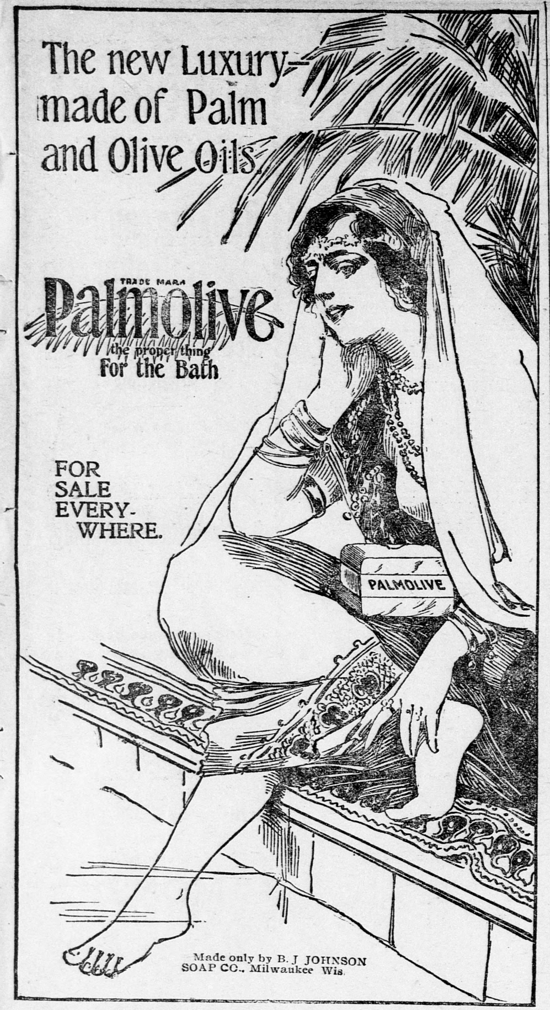
Slogan (1899): «The new Luxury - made of Palm and Olive Oils»

Property: Colgate-Palmolive Company

Producer website: https://www.colgatepalmolive.com

Palmolive Soap 1910
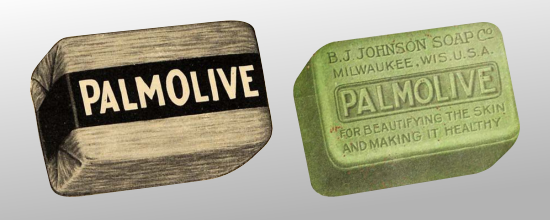
Palmolive Soap as it appeared in 1910 advertisements

Palmolive Soap, ad August 22, 1899
Palmolive Soap, ad August 25, 1899
Palmolive Soap, ad August 29, 1899
Palmolive Soap, ad September 1, 1899
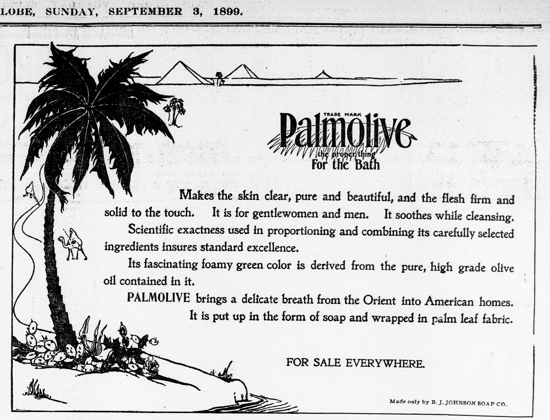
Palmolive Soap, ad September 3, 1899
Palmolive Soap, first advertisements in newspapers (The Saint Paul globe, St. Paul, Minn., 1899, from top: August 22, 25, 29, September 1, 3)

Palmolive Soap, ad April 1904
Palmolive Soap advertisement (The Century illustrated monthly magazine, April 1904)

Palmolive Soap, ad March 1910
Palmolive Soap advertisement: «The Easy Way To Beauty-Free» (Collier's, March 1910)

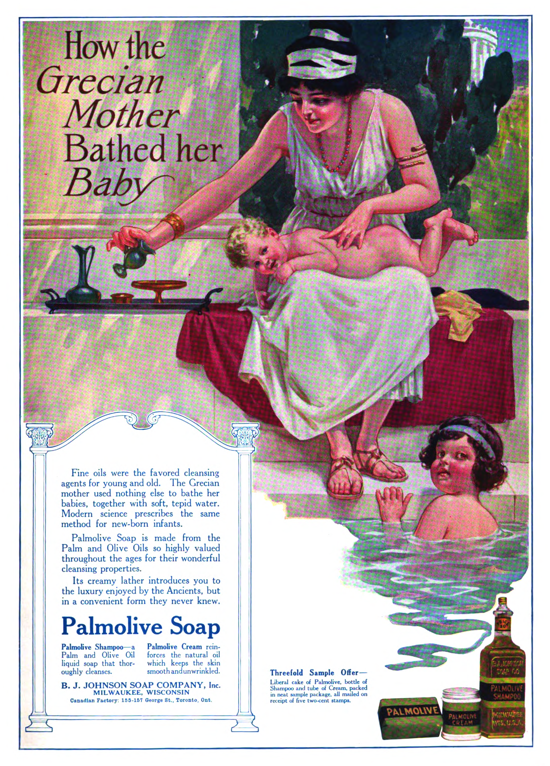
Palmolive Soap, ad March 1915
Palmolive Soap advertisement: «How the Grecian Mother Bathed her Baby» (The American Magazine, March 1915)

Palmolive Soap, ad August 1916
Palmolive Soap advertisement: «Ours the Greater Luxury» (The Ladies' Home Journal, August 1916, art by Coles Phillips)

Palmolive Soap, ad June 1917
Palmolive Soap advertisement: «Buying Palmolive 3,000 Years Ago» (People's Home Journal, June 1917, art by Willy Pogany)

Palmolive Soap, ad 1918
Palmolive Soap advertisement: «When Ancient Egypt Was Young» (1918, art by Neysa McMein)

Palmolive Soap, ad May 1919
Palmolive Soap advertisement: «The Oldest of Toilet Requisites» (The Ladies' Home Journal, May 1919, art by Coles Phillips)

Palmolive Soap, ad 1920
Palmolive Soap advertisement: «Re-Incarnation of Beauty» (1920, art by Neysa McMein)

Palmolive old factory
"A Day in the Palmolive Factory", pamphlet in Pdf (The Palmolive Company, 1925) «Dedicated to the sales force of The Palmolive Company by the advertising department»

Burdett J. Johnson and his son Caleb Elliott Johnson
The entrepreneurs who launched the Palmolive brand in 1898: Burdett J. Johnson (Buffalo, April 14, 1826 - Milwaukee, August 23, 1902), founder of B. J. Johnson & Company in 1864 (The Palmolive Company in 1917), and his son Caleb Elliott Johnson (Buffalo, June 7, 1857 - Jacksonville, August 8, 1924), who served as vice-president (1894-1902) and president (1902-1924) of the company.

Palmolive Soap in 2020
Palmolive Soap, advanced versions (2020)

Maybelline (mascara)


Maybelline logo 1917
Name: "Maybelline"

Categories: Beauty, Fashion

Subcategory: Mascara

Inventor: Thomas Lyle Williams

First producer: Maybell Laboratories (founded by Thomas Lyle Williams in Chicago, Illinois, in 1915 - renamed Maybelline in 1923)

Production start: 1917 - Chicago, Illinois, USA

First price: 75 cents

Features: The exact composition of the early Maybelline cake mascara is unknown, but it was most likely a sodium stearate cake mascara. Maybelline came in two shades, black (containing lamp black) and brown (containing iron oxides). The box included a rectangular cake of product stamped with the name Maybelline, a small bristle brush and a mirror attached to the inside of the lid. The product was applied by first wetting the cake, then using a small brush to lift and apply the colour to the eyebrows and eyelashes.

Interesting facts: Thomas Lyle Williams, a young entrepreneur from Chicago, noticed his older sister Mabel applying a mixture of Vaseline, ash and coal dust to her eyebrows to enhance her eyes. Inspired by the potential of her homespun solution, Thomas used a chemistry set to make a better one, but his first attempt was unsuccessful. So he commissioned Park-Davis, a wholesale drug manufacturing company, to make a suitable product for sale. This first product was named "Lash-Brow-Ine". In 1915 Thomas Williams founded Maybell Laboratories - so named after his sister Mabel, and began to advertise and sell his invention as a mail-order product. In 1917, with the assistance of Park-Davis, he began production and sale of a cake eyelash and eyebrow beautifier: this new product was named "Maybelline". After losing a trademark dispute in 1920, Williams could no longer use the name Lash-Brow-Ine, and Maybelline took its place. In the 1920s promotion play an important role in the success of the company, with a lot of advertising featured famous actresses such as Phyllis Haver, Ethel Clayton, Viola Dana, Ruth Roland and Natalie Moorhead. In the same years, the company expands beyond Maybelline cake mascara by adding a waterproof liquid version (1925), eyebrow pencils and eye shadow (1929). In 1996 the company was acquired by L'Oreal, and in 2001 became "Maybelline New York".

Quote (Thomas Lyle Williams): «What if I told you every woman could have a bit of that beauty in her own life? Is that so wrong?»

Property: Maybelline Co. - Maybelline New York - L'Oréal

Product website: http://www.maybelline.com

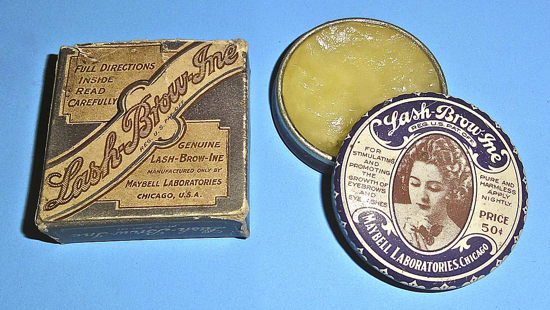
Lash-Brow-Ine 1915
Lash-Brow-Ine ad 1915
Maybelline, first packaging and first advertisement for "Lash-Brow-Ine", Maybell Laboratories' first product and precursor to Maybelline mascara (ad. from The Green Book Magazine, Chicago, Illinois, December 1915).

Maybelline cake mascara 1917 - top
Maybelline cake mascara 1917 - inside
Maybelline cake mascara 1917 - brush
Maybelline, first cake mascara (1917)

Maybelline ad 1920
Maybelline advertisement (The Meyer Brothers Druggist, Saint Louis, Missouri, January 1920)

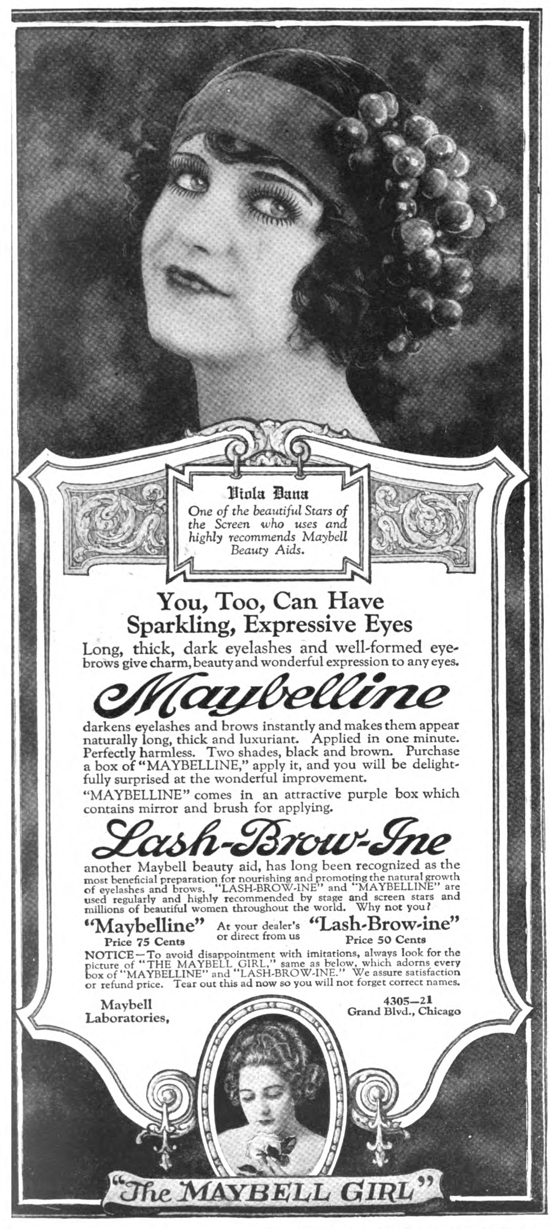
Maybelline ad 1920 - Viola Dana
Maybelline advertisement with American film actress Viola Dana (Photoplay Magazine, New York City, July 1920)

Maybelline ad 1920 - Ruth Roland
Maybelline advertisement with American film actress Ruth Roland (Photoplay Magazine, New York City, July 1920)

Maybelline liquid mascara 1925
Maybelline waterproof liquid mascara, first packaging and advertisement (1925)

Maybelline eye shadow and eyebrow pencils ad 1929
Maybelline, advertisement for eye shadow and eyebrow pencils introduced in 1929 (Photoplay Magazine, New York City, February 1930)

Maybelline cake mascara 1930s
Maybelline, new packaging for cake mascara introduced in early 1930s

Maybelline cake mascara 10-cent box 1932 - top
Maybelline cake mascara 10-cent box 1932 - inside
Maybelline, cake mascara 10-cent box (1932). During the Great Depression, Maybelline introduced a special smaller version of the original 75-cent box of cake mascara.

Maybelline ad 1934
Maybelline cake mascara gold metal box 1934
Maybelline, advertisement and packaging for cake mascara «in the new, ultrasmart gold and scarlet metal case» (ad. from Photoplay Magazine, New York City, April 1934).

Thomas Lyle Williams
Thomas Lyle Williams (Morganfield, 1896 - Los Angeles, Sept. 26, 1976), inventor of Maybelline mascara and founder of Maybelline Laboratories.

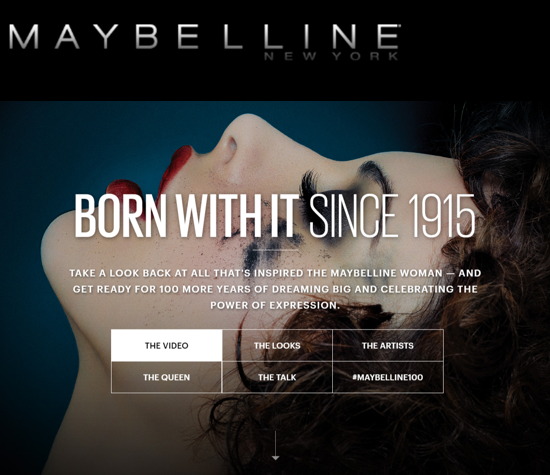
Maybelline 100th anniversary
Maybelline New York celebrates its 100th anniversary (1915-2015)

L'Oréal (hair dyes)


L'Oréal logo 1909
L'Oréal logo 1909
Original name: "L'Auréale"

Name: "L'Oréal"

Categories: Beauty, Fashion

Subcategory: Hair dyes

Inventor: Eugène Schueller

First producer: Société Française des Teintures Inoffensives pour Cheveux (Safe Hair Dye Company of France, founded by Eugène Schueller on July 30, 1909)

Invented in: 1907 (patent granted on March 24, 1908) - Paris, France

Production start: 1909 - 3 Rue d'Alger, Paris, France

Features: In 1907 Eugène Schueller, a young French chemist, created the first synthetic hair dye: L'Oréal, a blend of harmless chemical compounds. The dyes was an outstanding breakthrough at the time, providing a subtle range of colors in contrast to other methods on the market, which use henna or mineral salts but produce a bright, somewhat artificial look. Eugène Schueller registered two names for his product: "Black and Gold", a logical brand name for a hair colorant with black representing the spectrum of dark shades and gold the warm tones - a brand name which was however never used; "L'Auréale", a name inspired by a hairstyle in fashion at the time called "L'Auréole" from the Latin "aureola", a luminous halo. A few months later the name was simplified to "L'Oréal".

Interesting facts: In 1909, Eugène Schueller founded the company that will later become L'Oréal: Société Française des Teintures Inoffensives pour Cheveux. L'Oréal hair dyes obtained a great success, even beyond the borders of France, breaking new ground in Italy in 1910, Austria in 1911 and the Netherlands in 1913, even reaching as far afield as the United States, Canada, the UK and Brazil. The small company founded by Eugène Schueller in 1909 has become the number one cosmetic group in the world.

Slogan (1909): «L'Oréal rendant aux cheveux leur couleur et leur vigueur» - "L'Oréal makes the hair color and vigor"

Property: L'Oréal

Producer website: http://www.loreal.com

Eugène Schueller in 1907
Eugène Paul Louis Schueller (Paris, March 20, 1881 - Aug. 23, 1957), the French chemist and entrepreneur who invented L'Oréal hair dye, and founded the company. Photo taken in his kitchen, then transformed into a laboratory, 1907.

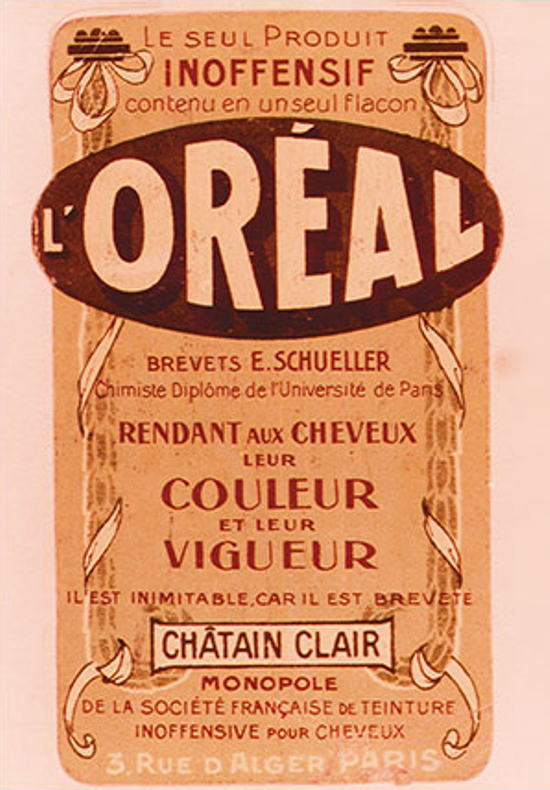
L'Oréal ad 1909
L'Oréal advertisement (1909): "L'Oréal rendant aux cheveux leur couleur et leur vigueur" (L'Oréal makes the hair color and vigor)

L'Oréal ad 1910
L'Oréal, hair-coloring school advertisement (1910): "L'Ecole de Teinture L'Oréal" (L'Oréal hair-coloring school). Eugène Schueller sets up a hair-coloring school on Rue du Louvre in Paris, which he personally oversees, using a former hair stylist from the Russian Court to demonstrate his ideas.

L'Oréal ad 1911
L'Oréal advertisement (1911) from La Parfumerie moderne, Paris. "Si vous voulez vendre des Teintures pour Cheveux (...) Une seule marque: L'Oréal" (If you want to sell Hair Dyes ... A single brand: L'Oreal).

L'Oréal ad 1914
L'Oréal advertisement (Feb. 14, 1914) by M. Lancelevée, from L'illustration, Paris. "Ne vous désolez pas!... en 30 minutes L'Oréal vous rendra la couleur et la jeunesse de votre chevelure" (Don't worry!... in 30 minutes L'Oréal will make the hair color and youth).

L'Oréal ad 1915
L'Oréal advertisement (May 1, 1915) by Fromentgérald Pary, from L'illustration, Paris. "L'Oréal teint bien sans danger en toutes nuances" (L'Oréal colors good without damage in all shades).

L'Oréal 100th Anniversary
L'Oréal celebrates 100 years (1909-2009) announcing the roll-out of 100 citizen projects around the world

Kleenex (facial tissues)


Kleenex logo 1924
Kleenex logo 1924
Name: "Kleenex"

Category: Health and Beauty

Subcategory: Facial tissues

Inventor / Producer: Cellucotton Products Co.
(formed in 1924 as a division of Kimberly, Clark and Co., founded in 1872 by John A. Kimberly, Havilah Babcock, Charles B. Clark, and Franklyn C. Shattuck)

Production start: June 12, 1924 - Neenah, Wisconsin, USA

First price: In 1926, Kleenex Absorbents 'Kerchief cost 35 cents in Boudoir size (sheets 6 by 7 inches), 65 cents in Professional (sheets 9 by 10 inches). A free 7-day sample pack supply was offered to try it.

Features: The first Kleenex handkerchiefs were made of "Cellucotton", a preparation from processed wood pulp. A variation of the cylinder machines, the Yankee paper machines dried the cellulose web on a single steam-heated cylinder featuring a polished surface, unlike the fourdrinier machine that dried the web in press rolls.

Interesting facts: During World War I, a shortage of cotton for bandages forced the military to look for an alternative. Kimberly-Clark came to the rescue with a "Cellucotton" (cellulose + cotton) product that would later become Kleenex. It was a clean product for dressing wounds and was also used in gas masks. After the war, the company faced a marketing dilemma as they had massive stockpiles of Cellucotton and a sudden end of demand for the product. In a stroke of marketing genius, Kimberly-Clark began to sell the war surplus as a cold cream and makeup remover. In 1920 Kimberly-Clark forms the company Cellucotton Products Co. to market Kotex (cotton + texture) sanitary napkins. In 1924 Kleenex (Cleansing + Kotex) was introduced by Cellucotton and first marketed to women as a disposable towel to use when removing cold cream. Made of the extra pulp from producing Kotex pads, Kleenex became a cleansing-cloth replacement. In a short time, however, consumers began using tissues as disposable handkerchiefs. The first pop-up tissue box appeared in 1928. In the USA, the Kleenex name has become genericized: the popularity of the product has led to the use of its name to refer to any facial tissue, regardless of the brand, and many dictionaries now include definitions in their publications defining it as such.

Slogan (1926): «We have found the only way ever known -that removes Cold Cream thoroughly -that remove it safely -that removes all dirt with it»

Property: Kimberly-Clark Corporation

Official website: https://www.kleenex.com

Kleenex, the origins
Kleenex, the origins. Left: Kimberly-Clark launches the Cellucotton, a substitute of absorbent cotton, made from wood (article from The Capital Times, Dec. 20, 1917). Center: Cellucotton Product Company is established to handle product (Appleton Post Crescent, Oct. 16, 1920). Right: Demand increases and plants expand (Appleton Post Crescent, Dec. 11, 1922).

Kleenex, patented logo
Kleenex, patented logo (1924, filed on July 12 and registered on November 25, for "Absorbent pads or sheets for removing cold cream")

Kleenex, early package 1924
Kleenex, early packages 1924
Kleenex Sanitary Cold Cream Remover, first packages (1924)

Kleenex, window 1926
Kleenex, window display Cellucotton product line (1926)

Kleenex, advertising 1926
Kleenex, advertising with famous American actress Dolores Costello (1926)

Kleenex, booklet 1926 cover
Kleenex, booklet 1926
Kleenex, booklet 1926 inside
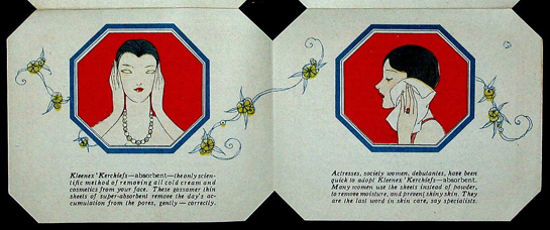
Kleenex Absorbents 'Kerchief, advertising booklet (Feb. 1926)

Kleenex, Good Housekeeping advertising 1926
Kleenex Sanitary Cold Cream Remover, advertisement (Good Housekeeping, Feb. 1926)

Kleenex, Theatre Magazine advertising 1926
Kleenex Sanitary Cold Cream Remover, advertisement (Theatre Magazine, May 1926)

Kleenex, pop-up tissue package 1928
Kleenex Absorbents 'Kerchief, regular and pop-up tissue package (1928)

Kleenex, pop-up box prototype 1929
Kleenex, pop-up box 1930
Kleenex Cleansing Tissues, pop-up box prototype (Feb. 1929) and first model (1930)

Kleenex, advertising 1930
Kleenex Cleansing Tissues, advertisement introduces new smart colored packages (1930)

Kleenex, True Romance advertising 1930
Kleenex Cleansing Tissues, advertisement with famous American actress Helen Morgan
(True Romance, Sept. 1930)

Kleenex, Pictorial Review advertising 1931
Kleenex Cleansing Tissues, advertisement with famous American actress Laura La Plante
(Pictorial Review, July 1931)

Kleenex, Bechberger and Kubach window 1938
Kleenex, Bechberger and Kubach window 1938 - zoom
Kleenex Disposable Tissues, window display (1938). The window of the Bechberger and Kubach drugstore, Sloane House, Sandusky (Ohio), featured a display entitled "IT'S KLEENEX TIME in America!". The display showed the Seven Dwarfs explaining why they liked Kleenex.

Kleenex, Kassis window 1938
Kleenex, Kassis window 1938 - zoom
Kleenex Disposable Tissues, window display (1938). The window of the Kassis store, Laramie (Wyoming), featured a large display of Kleenex with dolls and a mannequin.

Kleenex, packages evolution
Kleenex, packages timeline (1925-1966)

Kleenex 90th anniversary
Kleenex 2014
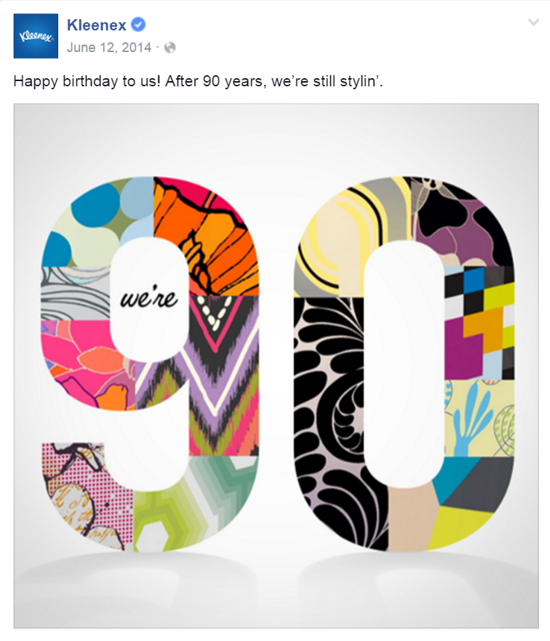
Kleenex celebrates its 90th anniversary (June 12, 2014) with a large-scale design project that involves collaboration with style icon Isaac Mizrahi. Bottom: Kleenex in their advanced versions.