Meccano


Meccano logo 1908
Meccano logo 1908
Names:
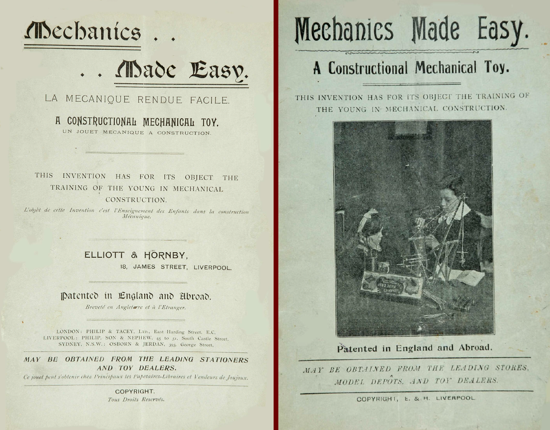
--- "Mechanics Made Easy" (1901)
--- "Simplified Mechanics" (1907)
--- "Meccano" (since Sept. 14, 1907)

Category: Toys

Subcategory: Construction set

Inventor: Frank Hornby

Invented in: 1898 - Liverpool, England, UK

Patent: January 9, 1901 (accepted November 30), UK

First producer: Meccano Ltd. (founded in Liverpool, May 30, 1908, by Frank Hornby)

Production start:
--- 1902 as "Mechanics Made Easy", UK
--- Since 1908 as "Meccano", worldwide

First price:
--- The first outfit marked "Mechanics Made Easy" (1902) cost 7 shillings 6 pence.
--- The first outfit trademarked "Meccano" (1908) cost 4 pence.

Features: In early newspaper advertisements, Meccano - born in 1901 under the name "Mechanics Made Easy" - was described as «a patent adaptable mechanical toy, with which boys may exercise they ingenuity in constructing cranes, bridges, wagons, shafting, etc. - in fact, an endless variety of models. The metal strips being perforated with holes, equidistant, enables them to be formed into the shapes (among others) enumerated». The first sets had a very limited range of parts, manufactured by various local firms, and the strips were made from thin tinplate steel with edges folded over to give strength. The boxes were long, thin, and attractively tin-printed. By 1904 the outfits included girders and gear wheels, three different sets were product, accessory outfits and manuals were introduced. In 1907, after a temporarily rebrand as "Simplified Mechanics", the very first "Meccano" trademark appeared on a new large box called "Meccano Kindergarten Outfit" (though, the design of the parts remained the same). Since then, "Meccano" became the official name, with "Mechanics Made Easy" in brackets as subtitle for 3/4 years and then cut off. In 1908 the boxes were large, the outfits were numbered from 1 to 6, and the parts were nickel plated. Through the years new designs, parts, and outfits were developed using different materials and technologies, for an always-modern toy.

Interesting facts: In 1898 Frank Hornby, a bookkeeper from Liverpool, began to design a system of interchangeable metal strips, plates, wheels, axles and gears, with nuts and bolts to connect the pieces, for the amusement of his two children. Supported by his employer David Elliott, Hornby got his new system patented in 1901, and started selling it as "Mechanics Made Easy" outfits, with parts produced by external businesses in Liverpool. From 1902 to 1907, advertisements began to appear in newspapers and magazines, model-building competitions were also advertised, new parts and sets were introduced, and with the support by chair of Engineering Henry Selby Hele-Shaw sales started to take off. In 1907 Hornby decided to rebrand his sets: the iconic "Meccano" trademark was registered, and sets carrying the new name made their first appearance. In the same year the first factory opened on Duke Street in Liverpool, and Meccano began to be exported to many countries, but it was not until 1908 that the new "Meccano Ltd." company came into being, when Hornby bought out his employer's stake in the business (until then the sets carried the monogram "E&H" or "Elliot and Hornby"). At the same time, the outfits evolved with the introduction of the nickel plating. In 1914 a large factory was built in Binns Road to churn out the new Meccano sets in increasing quantities, and in 1916 "Meccano Magazine" - edited by Frank Hornby and published by his Meccano Ltd. company - was launched to keep Guild clubs informed of each other's activities, as well as encourage the sales. For over 100 years, Meccano has inspired countless engineers, designers, architects and creative minds of all ages.

Slogan (1902): «Mechanics Made Easy. A Patent Adaptable Mechanical Toy»

Property: Meccano Ltd. - Spin Master Ltd.

Producer website: https://www.meccano.com
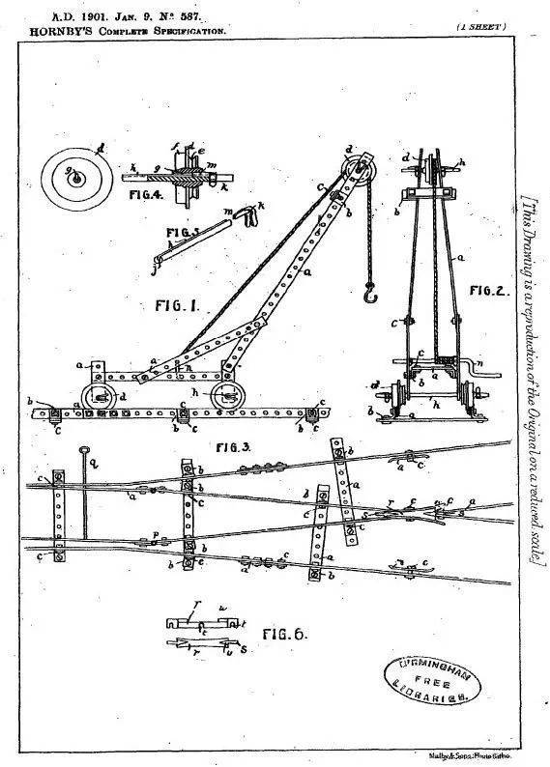

Meccano Patent 1901
Mechanics Made Easy, precursor to Meccano, patent (January 9, 1901, accepted Nov. 30) by Frank Hornby for "Improvements in Toy or Educational Devices for Children and Young People".

Meccano crane 1904
Mechanics Made Easy, crane (1904). This model, similar to the example in Hornby's patent, is made with Mechanics Made Easy first outfit.

Mechanics Made Easy first outfit 1904 box
Mechanics Made Easy first outfit 1904 box - front
Mechanics Made Easy first outfit 1904 box - contents
Mechanics Made Easy, first outfit (1904)

Mechanics Made Easy manuals 1904 - 1906
Mechanics Made Easy manuals (left: c. 1904, right: c. 1906)

Mechanics Made Easy advertisement 1902
Mechanics Made Easy, advertisement ("The Boy's Own Paper" weekly magazine, London, September 13, 1902). «MECHANICS MADE EASY. A Patent Adaptable Mechanical Toy, with which boys may exercise they ingenuity in constructing Cranes, Bridges, Wagons, Shafting, &c. - in fact, an endless variety of models. The metal strips being perforated with holes, equidistant, enables them to be formed into the shapes (among others) enumerated. No expense for tools. Charming occupation and toy indestructible. Price 7s. 6d., from G. Philip & Son, Ltd., 32 Fleet Street, London; Philip, Son & Nephew, South Castle Street, Liverpool; Leading Stationers, and Toy Dealers. Manufacturers: Elliot & Hornby, 18 James St., Liverpool.»

Simplified Mechanics box 1907
"Simplified Mechanics": temporarily rebranded box before "Meccano" trademark (1907)

Meccano Kindergarten Outfit 1907
Meccano Kindergarten Outfit, the very first outfit trademarked "Meccano" (late 1907). Produced for Christmas 1907 and sold until 1910, this outfit encouraged children to draw out simple models with a plastic ruler on squared paper in a drawing book before construction.

Meccano 1908 box
Meccano 1908 box - opened
Meccano 1908 box - content
Meccano first outfit (1908). Nickel plated parts are introduced, and the "Mechanics Made Easy" subtitle on the box will soon be cut off.

Meccano advertisement 1909
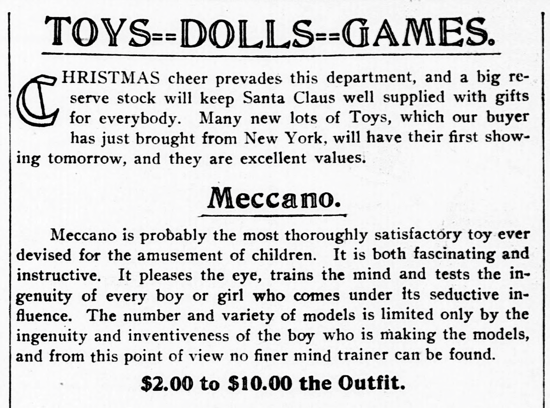
Meccano advertisement ("Evening star" newspaper, Washington, D.C., Dec. 17, 1909)

Meccano advertisement 1912
Meccano advertisement ("The daily Gate City" newspaper, Keokuk, Iowa, Dec. 1, 1912)

Meccano advertisements 1914
Meccano advertisements ("Popular Mechanics" monthly magazine, USA, Nov./Dec. 1914)

Meccano Magazine 1916 - 1981
Meccano Magazine, first issue (Sept. 1916, left) and last (Apr. 1981, right). Meccano Magazine was launched «to help Meccano Boys to have more fun than other boys» by inventor Frank Hornby (first editor), and published as bi-monthly by his company Meccano Ltd.

Frank Hornby
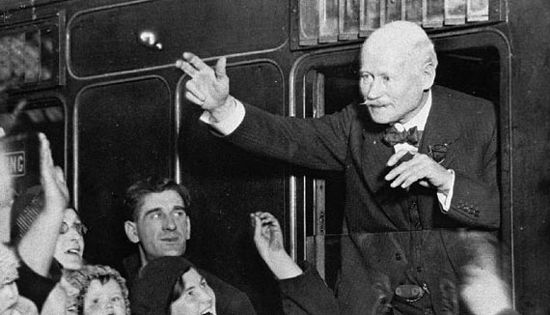
Frank Hornby (Liverpool, May 15, 1863 - Maghull, September 21, 1936), the inventor, businessman and politician who invented Meccano toys and founded Meccano Ltd.

Meccano 100th Anniversary and Frank Hornby 150th Anniversary
Meccano 100th Anniversary (1901-2001, left), and Frank Hornby 150th Anniversary (1863-2013, right). In 2001 Spin Master Corp., brand owner, launched a special Anniversary Edition to commemorate 100 years from the Meccano patent. In 2013 museums, communities and enthusiasts from all over the world celebrated 150 years of the inventor (poster by Brighton Toy and Model Museum).

Risk


Risk logo 1959
Risk logo 1959
Names:
--- "La Conquête du Monde" (1957)
--- "Risk! Continental Game" (1959)

Category: Games

Subcategory: Board games

Inventor: Albert Lamorisse

Invented in: 1957

Patent:
--- France: March 23, 1954
--- UK: March 23, 1955

First producers/distributors:
--- France: Miro Company (founded in Paris in 1936 by Fred Mirowitch and Leo J. Frankenthal, acquired by Hasbro in 1986)
--- USA: Parker Brothers (founded in Medford, Massachusetts, in 1883 by George S. Parker, acquired by Hasbro in 1991)

Production start:
--- France: 1957 as "La Conquête du Monde" (The Conquest of the World)
--- USA: 1959 as "Risk! Continental Game"

First price (1959): 7.50 USD

Features (referred to the 1959 Parker Brothers' "Risk! Continental Game"): Risk is a turn-based game for 3, 4, 5 or 6 players. The game is played on a board depicting a political map of the Earth, divided into forty-two territories, which are grouped into six continents. The object of the game is to occupy every territory on the board and in so doing, eliminate all other players. Players control armies with which they attempt to capture territories from other players, with results determined by dice rolls. Equipment:
--- A. Six sets of playing pieces, each set of a different color, consisting of a box of cubes and several oblong pieces in a separate box. Each cube represents one army and the oblong pieces are equivalent to ten armies.
--- B. A playing board showing a map of the six continents, each of which is subdivided into a number of territories.
--- C. A deck of 44 cards plus one Trade-mark card which is not used in the play of the game.
--- D. Six dice, 3 of which are red and 3 of which are ivory-colored.

Interesting facts: During the 1950s, Parker Brothers formed an affiliation with the Miro Company in Paris for the manufacture and distribution of their games in France. In exchange, Parker Brothers agreed to manufacture and distribute some of Miro's games in the United States. In the summer of 1957, Mr. Boisseau of Miro approached Parker Brothers with "La Conquête du Monde" (The Conquest of the World), a game invented by French filmmaker, film producer, and writer Albert Lamorisse, best known for his award-winning short films like "Le Ballon rouge" (The red balloon, 1956). After extensive testing, the French game's rules were adapted for American tastes, and, in 1959, Parker Brothers launched "Risk! Continental Game". Through the years, the game has become a household name all around the world. In addition to the original version of 1959, a number of official variants and not-licensed clones of Risk have been produced over the years. Hasbro bought Miro Company in 1986, and subsequently Parker Brothers in 1991.

Property: Miro Company - Parker Brothers - Hasbro, Inc.

Producer website: http://www.hasbro.com

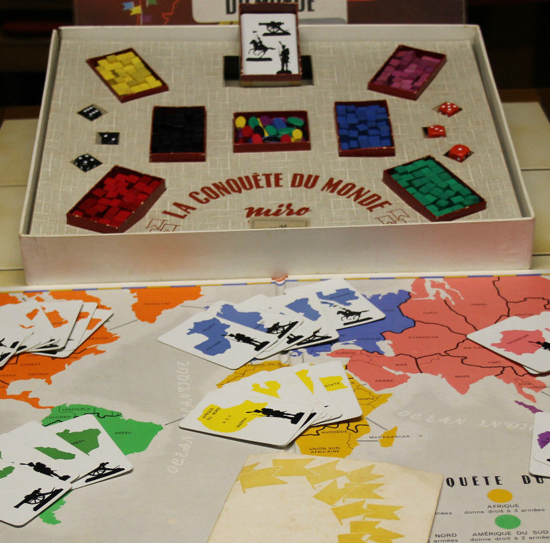
La Conquête du Monde, box front
La Conquête du Monde, box
La Conquête du Monde, box content
La Conquête du Monde, box content zoom
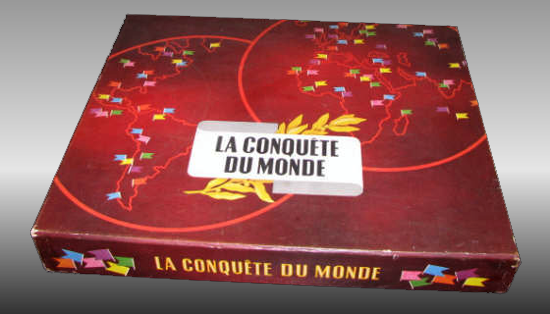
La Conquête du Monde (The Conquest of the World), original version of the board game Risk (1957), invented by Albert Lamorisse, produced and distributed by Miro Company

Albert Lamorisse
Albert Lamorisse (Paris, January 13, 1922 - Karaj, June 2, 1970), the French filmmaker, film producer, and writer, who invented the board game "La Conquête du Monde" (The Conquest of the World) in 1957, original version of the game Risk. Lamorisse is best known for his award-winning short films, like "Le Ballon rouge" (The red balloon, 1956), which won numerous awards, including an Oscar for Lamorisse for the best original screenplay, and the Palme d'Or for short films at the Cannes Film Festival.

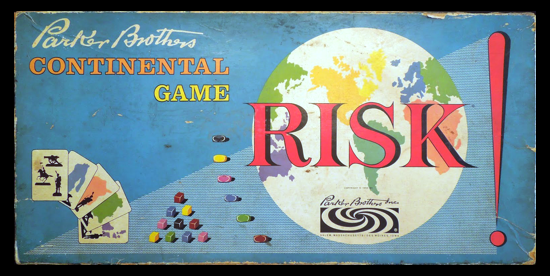
Risk first version 1959 - box front
Risk first version 1959 - box opened
Risk first version 1959 - box opened right-view
Risk first version 1959 - box content
Risk first version 1959 - box opened top-view
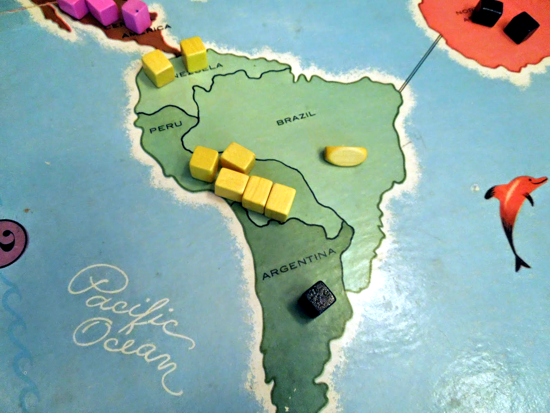
Risk first version 1959 - board top
Risk first version 1959 - board bottom-left
Risk first version 1959 - board bottom-right
Risk first version 1959 - cards
Risk first version 1959 - dice
Risk! Continental Game, first version of the board game Risk by Parker Brothers (1959)

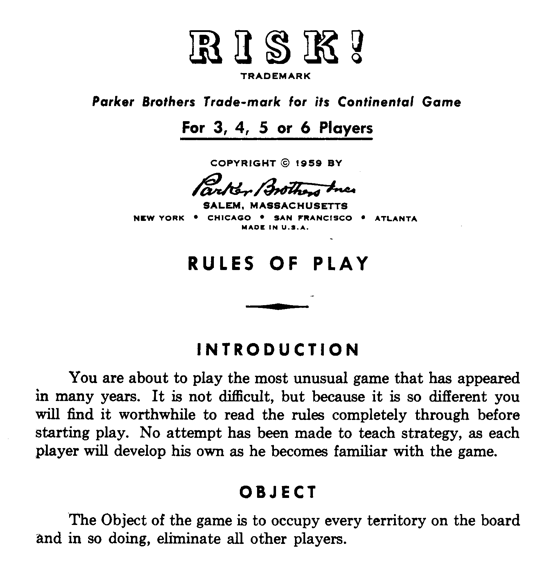
Risk 1959, instruction manual
Risk, introduction to the game from the instruction manual (1959)

Risk advertising 1961
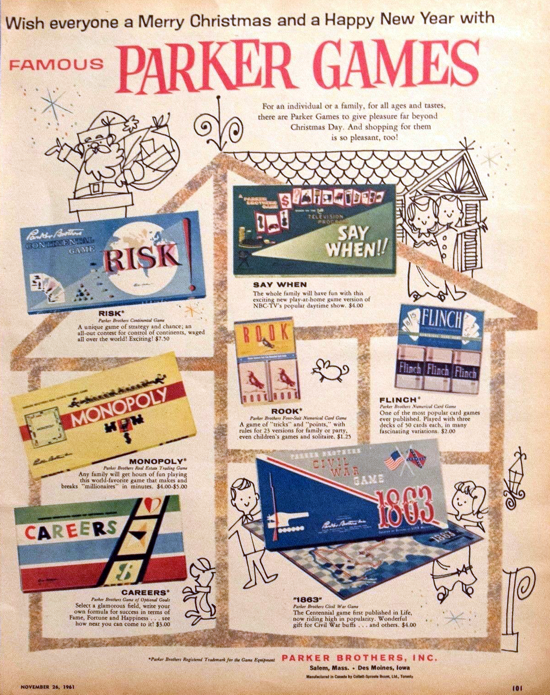
Risk advertising Christmas 1961
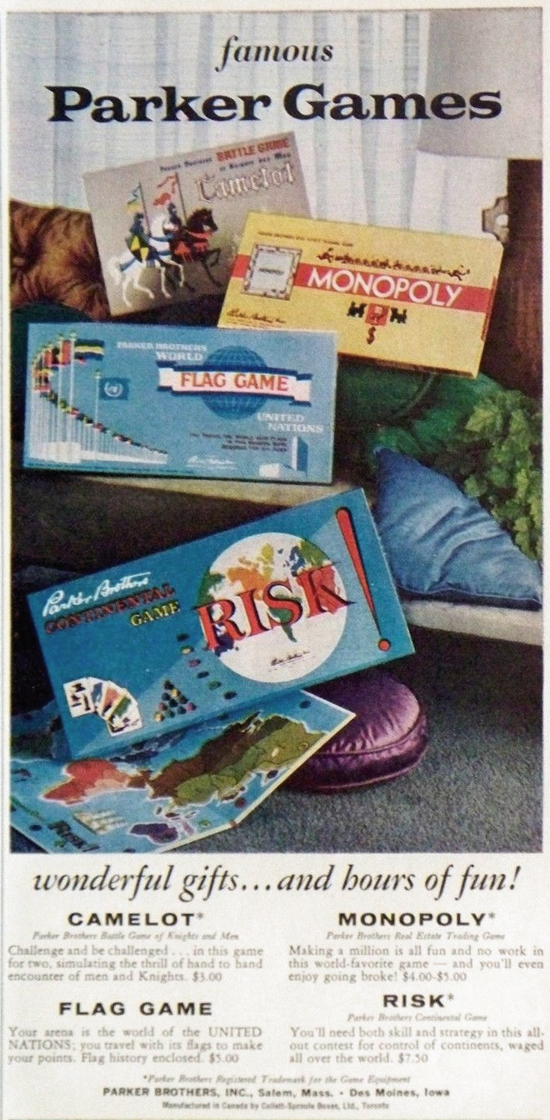
Risk advertising (1961)

Risk advertising 1966
Risk advertisement: «He conquered the world in one afternoon!» (1966)

Risk 60th Anniversary Edition box
Risk 60th Anniversary Edition
Hasbro celebrate 60 years of Risk (1959-1999). This special 60th Anniversary edition of the Risk game celebrates its legacy with premium packaging and game pieces. For true Risk fans, the included Game Guide reveals the history of the Risk strategy game. It also features 5 ways to play the Risk board game including the classic game plus the original 1957 La Conquête du Monde rules.

Monopoly


Monopoly logo 1935
Monopoly logo 1935
Original name: "The Landlord's Game" (1904)

Name: "Monopoly" (1935)

Category: Games

Subcategory: Board games

Inventor: Elizabeth Magie

First producer: Economic Game Company (founded in 1906 New York by Elizabeth Magie and other fellow Georgists)

Invented in: 1903 - Arden, New Castle County, Delaware, USA

Production start: 1906 as "The Landlord's Game" - 1935 as "Monopoly" - USA

Features: The Landlord's Game is a realty and taxation game, which is considered to be the direct inspiration for the board game Monopoly. The set had rules for two different games, anti-monopolist and a monopolist. The anti-monopolist rules reward all during wealth creation while the monopolist rules had the goal of forming monopolies and forcing opponents out of the game. A win in the anti-monopolist, or Single Tax version and later called by Magie as "Prosperity Game", was when the player having the lowest monetary amount has double his original stake. The board featured a track around the outside edge of the board split into blocks representing properties and had their purchase price, and their rental value listed in the block. New York City’s Broadway, Fifth Avenue, and Wall Street were the top properties in price and rent. The published game included Chance cards with quotes attributed to Thomas Jefferson, John Ruskin and Andrew Carnegie. From the 1904 patented version to the published 1906 version, the property names were changed and the rule for increased rent for multiple railroad owned.

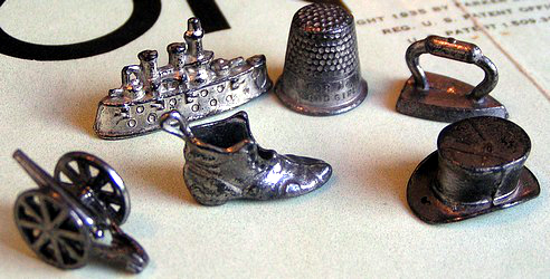
Interesting facts: In 1902 to 1903, Elizabeth Magie designed The Landlord's Game and play tested it in Arden, Delaware. The game was created to be a "practical demonstration of the present system of land grabbing with all its usual outcomes and consequences". She based the game on the economic principles of Georgism, a system proposed by Henry George, with the object of demonstrating how rents enrich property owners and impoverish tenants. In 1904, a patent on the game was granted; in 1906 Magie and other fellow Georgists formed a company, Economic Game Company, in New York to publish the game. In the United Kingdom it was first published in 1913 by the Newbie Game Company, formed by a Liberal Committee from the village of Newbie in Dumfries, under the title Brer Fox an' Brer Rabbit. On September 23, 1924, a second patent was issued to Magie for The Landlord's Game. In 1932, Adgame Company (Inc.) published The Landlord's Game and Prosperity under this patent, which included a new set of rules. Magie held the patent until 1935: in that year Charles Darrow, a domestic heater salesman, sold his version of the game to Parker Brothers Inc. under the name "Monopoly", and Magie sold her patent to the company. Monopoly was first marketed in a Standard Edition, with a small black box and separate board, and in a larger Deluxe Edition, with a box large enough to hold the board. Parker Brothers sets were the first to include metal tokens for playing pieces. In 1991 Parker Brothers was acquired by Hasbro.

Property: Hasbro, Inc.

Producer website: http://www.hasbro.com

The Landlord's Game 1903
The Landlord's Game, handmade board (1903)

The Landlord's Game patent 1904
The Landlord's Game, figure from the first Patent granted to Elizabeth Magie (Jan. 5, 1904, filed Mar. 23, 1903)

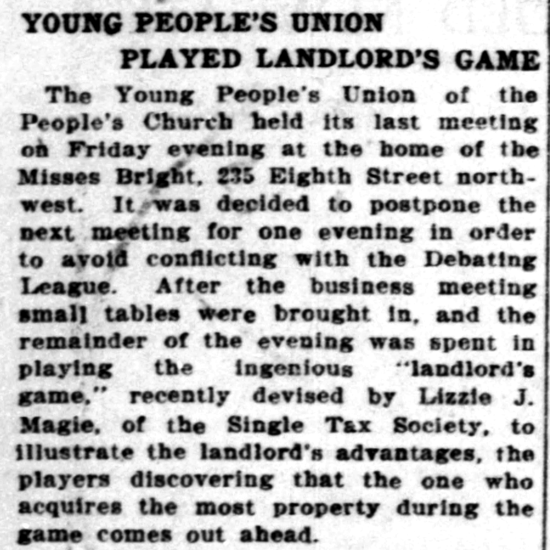
The Landlord's Game newspaper article 1903
The Landlord's Game in a 1903 newspaper article (The Washington times, Washington D.C., February 14). «YOUNG PEOPLE'S UNION PLAYED LANDLORD'S GAME - The Young People's Union of the People's Church held its last meeting on Friday evening at the home of the Misses Bright, 235 Eighth Street north-west. (...) After the business meeting small tables were brought in, and the remainder of the evening was spent in playing the ingenious "landlord's game", recently devised by Lizzie J. Magie, of the Single Tax Society, to illustrate the landlord's advantages, the players discovering that the one who acquires the most property during the game comes out ahead».

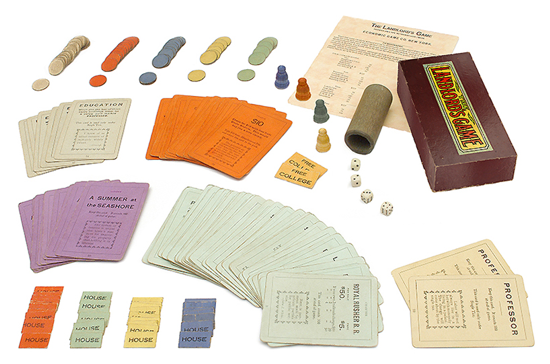
The Landlord's Game 1906 board
The Landlord's Game 1906 content
The Landlord's Game 1906 playing pieces
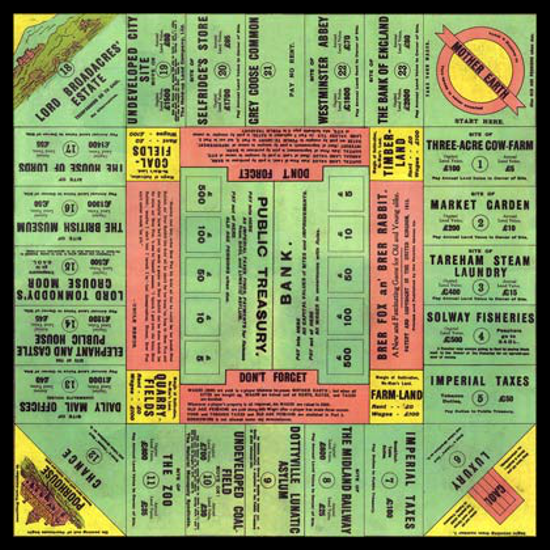
The Landlord's Game, replica based on the Economic Game Co. original (1906)

Brer Fox an' Brer Rabbit 1913 box cover
Brer Fox an' Brer Rabbit 1913 board
Brer Fox an' Brer Rabbit, UK variant of The Landlord's Game
(Newbie Game Company, 1913)

The Landlord's Game patent 1924
The Landlord's Game, figure from the second Patent granted to Elizabeth Magie
(Sept. 23, 1924, filed Apr. 28, 1923)

The Landlord's Game and Prosperity 1932
The Landlord's Game and Prosperity
(Adgame Company Inc., 1932)

Monopoly patent 1935
Monopoly, figure from the Patent granted to Charles Darrow
(Dec. 31, 1935, filed Aug. 31)

Monopoly 1935 box
Monopoly 1935 box cover
Monopoly 1935 box and board
Monopoly 1935 box opened
Monopoly 1935 box content
Monopoly 1935 tokens
Monopoly, first standard edition (Parker Brothers Inc., 1935)

Monopoly advertisement 1935
Monopoly newspaper advertisement (Evening star, Washington, D.C., December 5, 1935)

Monopoly advertising 1935-1936
Monopoly advertisements (Parker Brothers Inc. - Left: Newsweek, November 9, 1935 - Right: Liberty, November 28, 1936)

Elizabeth Magie
Elizabeth "Lizzie" J. Phillips née Magie (Macomb, 1866 - Arlington, 1948), the American game designer who invented The Landlord's Game, precursor to Monopoly

Monopoly 80th anniversary
Monopoly 80th anniversary edition 2015
Hasbro celebrate the 80th anniversary of Monopoly (1935-2015) with a special edition which included tokens from the 1930s all the way to the 2000s