Ryanair


Ryanair logo 1985
Ryanair logo 1985
Names:
--- "Danren Enterprises" (Nov. 28, 1984)
--- "Ryanair" (since 1985)

Category: Transportation

Subcategory: Airlines

Founded: Nov. 28, 1984 - Dublin, Ireland

Founders:
--- Christopher Ryan
--- Tony Ryan
--- Liam Lonergan

Operations start: July 8, 1985

Features: Ryanair began operations on July 8, 1985 with daily flights on a 15-seater EMB 110 Embraer Bandeirante turboprop aircraft, from Waterford to London Gatwick. First cabin crew recruits must be less than 5ft. 2ins. tall in order to be able to operate in the tiny cabin of the aircraft. The 90-minute flight, Waterford's first international scheduled air service, departed at 8.30am, with the return flight departing from Gatwick at 7pm. On May 23, 1986 Rayanair launched a second route Dublin - London Luton, operated by two 46-seater BAE748 turboprop aircraft.

Interesting facts: In 1975, Irish businessman Tony Ryan founded Guinness Peat Aviation (GPA), a commercial aircraft sales and leasing company based in Shannon, Ireland. During the 1980s the company became the world's largest commercial aircraft lessor, but in early '90s economic depression undermined this commercial success, the company over-reached itself, and in 1992 it ran into debt problems. Ryan lost control of the company; however, in 1985 he had already launched a little airline, Ryanair (named after him), with co-founders Christopher "Christy" Ryan, godfather to Tony's second son Declan and worker at GPA on the sales team, and Liam Lonergan, owner of Irish travel agent Club Travel. With a share capital of just £1, and a staff of 25, they began to charter a 15-seater aircraft to bring small groups on business and leisure trips between Waterford and London Gatwick. In 1986, Ryanair obtained permission from the regulatory authorities to challenge the British Airways and Aer Lingus' high fare duopoly on the Dublin-London route; services were launched with two 46-seater aircraft. The launch fare of £99 return was less than half the price of the British Airways and Aer Lingus lowest return fare of £209. With two routes in operation, Ryanair carries 82,000 passengers in its first full year in operation. Thirty years later, in 2016, Ryanair was the largest European airline by scheduled passengers flown, and carried more international passengers than any other airline.

Property: Ryanair

Official website: https://www.ryanair.com

Ryanair announcement 1985
Ryanair getting ready to begin operations (announcement: Flight International magazine, June 22, 1985). «Ryanair starts Waterford-London link. New airline Ryanair is to launch a daily service from Waterford in south-east Ireland to London Gatwick on July 1. The carrier will operate a 15-seat Embraer Bandeirante on the route. The new service provides a welcome boost for Waterford's regional airport, which was hard hit by the collapse of Irish commuter airline Avair».

Ryanair, first aircraft 1985
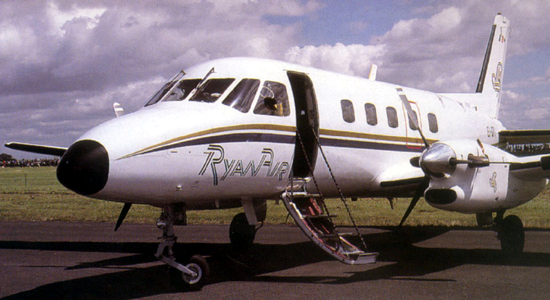
Ryanair's Bandeirante 1985
Ryanair, first aircraft operated by the company (July 8, 1985). Ryanair's first route Waterford - London Gatwick was operated by a 15-seater EMB 110 Embraer Bandeirante turboprop aircraft.

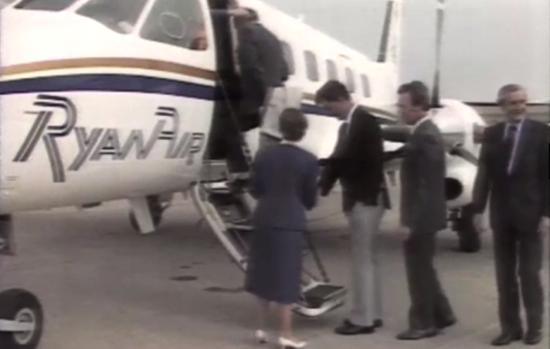
Ryanair inaugural flight video 1985
Ryanair inaugural flight - video (July 8, 1985). Click the image to see the clip (1 min.) archived by RTÉ.ie, Raidió Teilifís Éireann, Ireland's National Public Service Broadcaster.

Ryanair's timetable 1986 - front
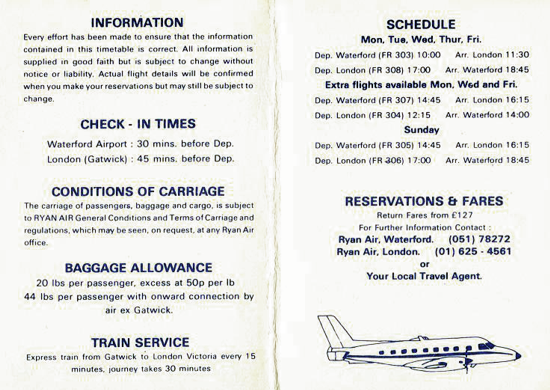
Ryanair's timetable 1986 - back
Ryanair, early timetable (January-March 1986)

Ryanair announcement 1986
Ryanair getting ready to launch the second route (announcement: Flight International magazine, May 10, 1986). «RyanAir starts Luton service. Irish carrier RyanAir begins Dublin-Luton services on May 23 using two ex-Dan-Air HS.748s. It plans to undercut the existing services of British Airways, Aer Lingus, and Dan-Air with an £86.50 no-restrictions return fare».

Ryanair, secound route departure 1986
Ryanair's BAE748, 1986
Ryanair, second aircraft operated by the company (May 23, 1986). Ryanair's second route Dublin - London Luton was operated by two 46-seater BAE748 turboprop aircraft, known as "The Spirit of Ireland".

Ryanair founders: Christopher Ryan, Tony Ryan, Liam Lonergan.
Ryanair founders: Christopher "Christy" Ryan (left), Thomas Anthony "Tony" Ryan (center), and Liam Lonergan (right).

Ryanair 30th Anniversary 1985-2015
Ryanair 30th Anniversary (1985-2015). Ryanair celebrate 30 years looking back at travel with Ryanair in 1985 compared to 2015.

Princess Cruises


Princess Cruises logo 1965
Princess Cruises
logo 1965
Name: "Princess Cruises"

Category: Transportation

Subcategory: Shipping

Founded: Nov. 14, 1965 - Seattle, Washington, USA

Founder / First president: Stanley B. McDonald

Operations start: December 3, 1965

Features: Founded in 1965, Princess Cruises began operations on December 3, 1965, carrying 400 passengers aboard the "Princess Patricia" Turbo-Electric Vessel from Los Angeles to Mexico, calling at La Paz, Puerto Vallarta, Acapulco and Mazatlan. In 1967 they chartered a more specific cruise ship, "Princess Italia", and in 1968 the third "Princess Carla" ship, thus continuing the series of Mexican Riviera cruises. In June 1969 Princess Cruises inaugurated the first series of summer cruises to Alaska.

Interesting facts: In 1962 entrepreneur Stanley B. McDonald bought a ship, the cruise vessel "Yarmouth", to operate as a hotel at the World's Fair in Seattle, where his company Air Mac provided all the ground transportation equipment; the ship sailed from San Francisco to Victoria B.C., then down to the fair for a 10-day cruise. For four days of the cruise the ship was used as a hotel while people onboard visited the fair. This experience inspired McDonald to try a new businness, so in 1965 he decided to found Princess Cruises.
The popular American television series "The Love Boat", aired on the ABC Television Network from 1977 to 1986, was set aboard many of Princess' ships in destinations around the globe; the two ships featured heavily were "Pacific Princess" and "Island Princess". To celebrate their 50th Anniversary, on December 3, 2015 Princess Cruises reunited The Love Boat cast aboard Pacific Princess in the Port of Los Angeles.

Quote (Stanley B. McDonald): «The call of the "Mexican Riviera" was coined by our people as I remember. Now everyone refers to it as the Mexican Riviera».

Property: Princess Cruise Lines, Ltd.

Official website: http://www.princess.com

Canadian Pacific Princess Cruises brochure 1965 - cover
Canadian Pacific Princess Cruises brochure 1965
Princess Cruises before Princess Cruises (summer 1965). This brochure offered 7-days summer cruises in Alaska - from May to August, from Vancouver to Skagway and return - aboard Canadian Pacific's "Princess Patricia", the first ship chartered by Stanley McDonald in the fall of the same year to start his businness. The Princess Patricia was a very popular, reliable ship: despite its tiny size, it had eight sumptuous wood-paneled suites with large living rooms, a large selection of outside upper/lower berth cabins, and outdoor activities included shuffleboard played atop decks.

Princess Cruises - Princess Patricia 1965
Princess Patricia, the first ship operated by Princess Cruises, docked in Vancouver during the first Princess Cruises management. On December 3, 1965, Princess Patricia's first cruise took 400 passengers from Los Angeles to Mexico, calling at La Paz, Puerto Vallarta, Acapulco and Mazatlan, thus inaugurating the first series of 14-day cruises to Mexico, until april 1966. This Turbo-Electric Vessel, 6,082-ton, 356-by-56 foot, built in Scotland 1949 and converted to cruise liner in Canada 1963, returned under the Princess banner for a second Mexican Riviera cruise in winter 1966/67, before being left to the exclusive management of its owner Canadian Pacific. Demolished in Taiwan 1995.

Princess Cruises dinner menu 1965 - cover
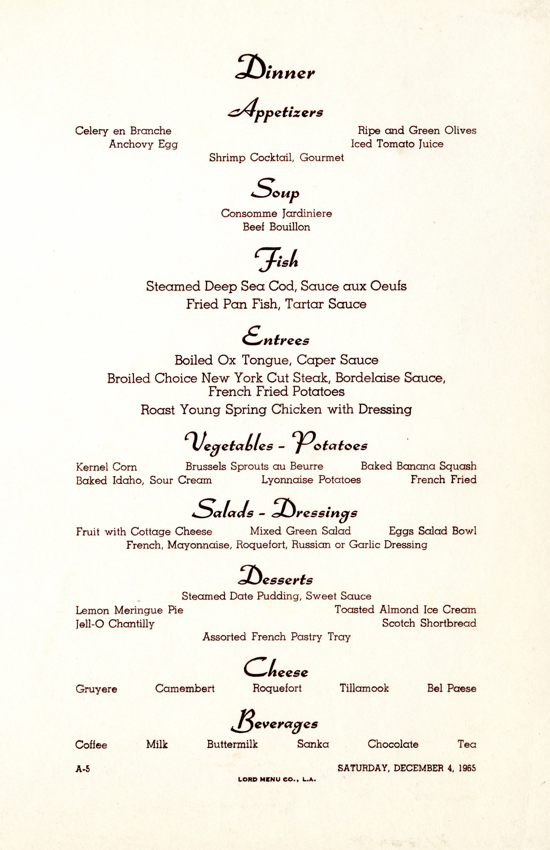
Princess Cruises dinner menu 1965
Princess Cruises Dinner Menu (December 4, 1965)

Princess Cruises brochures 1965/1966
Princess Cruises brochures (1965/66)

Princess Cruises - Princess Italia 1967
Princess Italia, the second ship operated by Princess Cruises, in Acapulco (1967, under charter to Princess but still with Oltremare's triangle funnel logo). Princess Italia made her maiden departure from Los Angeles on December 15, 1967. This cruise ship, 12,083-ton, 489-by-68 feet, 452 passenger plus 240 crew, was built in Italy 1967 as "Italia" for Crociere d’Oltremare, then chartered by Costa Lines and subchartered to Princess Cruises, who marketed her as "Princess Italia", but never officially renamed her. On June 3, 1969 Princess Italia was also used for the first Alaskan cruise from San Francisco. Demolished in Gujarat, India 2012.

Princess Cruises logo 1968
Princess Cruises introduce their iconic "Seawitch" logo (1968)

Princess Cruises - Princess Carla 1968
Princess Cruises - Princess Carla 1968 docked
Princess Carla, the third ship operated by Princess Cruises (1968). Princess Carla made her maiden departure from Los Angeles on December 19, 1968; it was the first vessel to carry the iconic "Seawitch" funnel logo. This cruise ship, 20,469-ton, 600-by-80 feet, 452 passenger, was built in France 1951 as "Flandre" for French Line, then sold in 1967 to the Italian firm Costa Cruises, who renamed her "Carla C". In 1968 the ship was chartered to Princess Cruises, who marketed her as "Princess Carla", but never officially renamed her. Demolished in Turkey 1994.

Princess Cruises advertisement 1968
Princess Cruises advertisement (1968, Princess Italia and Princess Carla cruises)

Princess Cruises brochures 1970/1971/1972
Princess Cruises brochures (1970/71/72)

Princess Cruises - Stanley B. McDonald
Stanley B. McDonald (Alberta, October 13, 1920 – Seattle, November 20, 2014), entrepreneur, founder of Princess Cruises

Princess Cruises 50th Anniversary - Pacific Princess 2015
Princess Cruises 50th Anniversary (1965-2015). On December 3, 2015, Princess Cruises celebrated their 50 years recreating the exact route of the cruise line's original Princess Patricia's maiden voyage (December 3, 1965) - from Los Angeles to Mexico - on board the 30,277-ton Pacific Princess (above).

Central Japan Railway Company


Central Japan Railway Company logo 1987
JR Central logo 1987
Names:
--- "Central Japan Railway Company"
--- "JR Central" (abbrev.)
--- "JR Tokai" (Japanese abbrev.)

Category: Transportation

Subcategory: Railroad

Founded: April 1, 1987 - Tokyo, Japan

Founder: Japan Railways Group (JR Group)

First president: Hiroshi Suda (Kyoto, January 28, 1931)

Operations start: March 31, 1987 at 11 pm the first JR Central train left from Tokyo Station to Nagoya Station (April 1, 7.27 am)

Features: In 1987, the year of its foundation, the Central Japan Railway Company (JR Central, or JR Tokai in Japanese) was one of the following seven companies owned by the new Japan Railways Group.
• Three main passenger companies:
--- 1) Central Japan Railway Company (JR Central);
--- 2) West Japan Railway Company (JR West);
--- 3) East Japan Railway Company (JR East).
• Three passenger companies for the smaller islands:
--- 4) Kyushu Railway Company (JR Kyushu);
--- 5) Shikoku Railway Company (JR Shikoku);
--- 6) Hokkaido Railway Company (JR Hokkaido).
• One company for freight transportation:
--- 7) Freight Railway Company (JR Freight).

Interesting facts: Central Japan Railway Company began operating on April 1, 1987 upon the privatization and breakup of the Japanese National Railways (JNR), a state-controlled agency that maintained a near monopoly over all railway business in Japan since its inception in 1949. In 1987 the JNR had been dissolved, and in its place stood seven companies as described above.
In the same year, a state agency that held all of the stock in the seven companies, the Japan National Railway Settlement Corporation (JNRSC), was also created. A year later, JR Tokai Bus Company was established, and automobile transport business was also transferred to the company.
By 2017, 30 years after its foundation, JR Central operated:
- the Tokaido Shinkansen - the world's first high-speed rail route created by Japanese National Railways (JNR) in 1964, linking Tokyo, Nagoya, and Osaka;
- 12 conventional lines centered on the Nagoya and Shizuoka City areas.

Property: Central Japan Railway Company

Official website: http://jr-central.co.jp

Japanese National Railways end, March 31, 1987
Japanese National Railways end, ceremony March 31, 1987
Japanese National Railways, president Takaya Sugiura on March 31, 1987
Japanese National Railway stops operations (Tokyo, March 31, 1987). Special free one-day tickets for all Japanese lines were issued on March 31, 1987. In a public ceremony at midnight, Takaya Sugiura - the last president of the Japanese National Railways (JNR) - rode a "C-56160" steam locomotive at Shiodome Freight Terminal in Minato, Tokyo, and blew the whistle to mark the end of the 115-year-old national railways. Locomotive "C-56160", built by the Japanese Government Railways (JGR) from 1935 to 1939, and later operated by Japanese National Railways (JNR), is preserved in operating condition by JR West at Umekoji Steam Locomotive Museum.

JR Central, celebration at Tokyo Station, April 1, 1987
JR Central: first train from Tokyo, April 1, 1987
Central Japan Railway Company starts operations (Tokyo, April 1, 1987). On March 31, 1987 at 11 pm, the first JR Central train "EF 58-122" left for the maiden voyage from Tokyo Station to Nagoya Station, where it arrived the next day at 7.27 am. On a head mark, the new orange "JR" logo and "Best regards JR Tokai". Locomotive "EF 58-122" was built in 1957 by Hitachi, and cut up at Hamamatsu Works in January 2009.

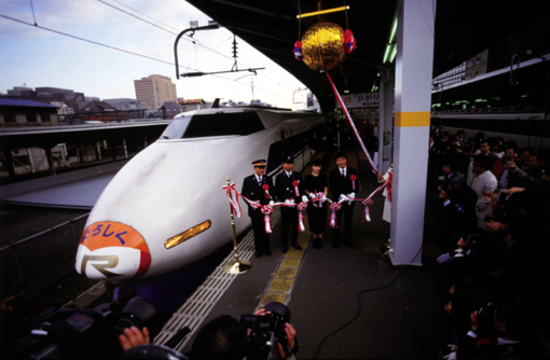
JR Central starts to operate the Tokaido Shinkansen, April 1, 1987
First bullet-train Tokaido Shinkansen operated by JR Central, April 1, 1987
Central Japan Railway Company starts to operate the Tokaido Shinkansen high-speed line (Tokyo, April 1, 1987). A so-called "bullet train" Shinkansen 100 series left from Tokyo Station showing the new company brand at the head mark.

JR Central commemorative medal, April 1, 1987
JR Central commemorative stamp Steam Locomotive 137, April 1, 1987
JR Central commemorative stamp Maglev MLU002, April 1, 1987
Japan Railway medal and postage stamps (April 1, 1987) issued to commemorate the establishment of the new railway business system from public corporation (JNR) to private enterprise (JR). The two depicted trains are: the first ever steam locomotive built in Japan, "No. 137" (originally "No. 221") completed in 1893 by JNR / IGR Kobe Works, and the prototype "Maglev MLU002" (Magnetic Levitation, U-shaped guideway) built in 1987 by JR Central for experimental purposes only.

JR Group first timetable April 1987
Japan Railway Group, first timetable (April 1987)

JR Central, first TV commercial June 1987
Central Japan Railway Company, first TV commercial (June 1987). To promote the Shinkansen high-speed line, the "Cinderella Express" campaign began, targeting young people by depicting a situation in which a couple share a long-distance relationship. Title and background music: from a song by Yumi Matsutoya; actress: Misa Kawai.

JR Central 30th Anniversary, April 1, 1987-2017
Central Japan Railway Company 30th Anniversary (April 1, 1987-2017)

Lufthansa


Lufthansa logo
Lufthansa logo 1926
by Otto Firle 1918
Names:
--- "Deutsche Luft Hansa" (1926)
--- "Deutsche Lufthansa" (1933)
--- "DLH" (abbreviated, 1933)
--- "Aktiengesellschaft für Luftverkehrsbedarf" (1953)
--- "Luftag" (abbreviated, 1953)
--- "Deutsche Lufthansa Aktiengesellschaft" (1954)
--- "Lufthansa" (abbreviated, 1954)

Category: Transportation

Subcategory: Airlines

Founded: January 6, 1926 - Berlin, Germany - as "Deutsche Luft Hansa".

Founders: Merger between Deutscher Aero Lloyd (an airline formed in 1923 as a co-operation between the shipping companies Norddeutscher Lloyd and Hamburg America Line) and Junkers Luftverkehr, the in-house airline of Junkers.

Operations start: April 6, 1926, with the first scheduled flight from Berlin to Zürich via Halle, Erfurt and Stuttgart, operated by a Fokker-Grulich F II. The fleet consisted of 162 aircraft, of 18 different types. A flying expedition to China was the event of the year.

Operations end: April 1945 (Company formally dissolved on January 1, 1951).

Refounded (not as legal successor): January 6, 1953 - Cologne, Germany - as "Aktiengesellschaft für Luftverkehrsbedarf", abbrev. "Luftag"; renamed "Deutsche Lufthansa Aktiengesellschaft", abbrev. "Lufthansa", on August 6, 1954, when the company acquired the name and logo of the liquidated Deutsche Lufthansa thus continuing the tradition of a German flag carrier of that name.

Refounders: Luftag stems directly from the Bureau Bongers, formed in 1951 to prepare "the first rough sketches". Hans M. Bongers, traffic manager of the old Lufthansa, was appointed aviation adviser to the Minister of Transport and set up the Bureau Bongers in two rooms in the Cologne University building. This was followed, in January 1953, by the creation of a company with a capital of which major shareholders are the Federal German Government (74%), the State of North Rhine-Westphalia, and Federal German Railways, together with 125 smaller holdings, mainly in travel and transport. Dr. Kurt Weigelt, deputy chairman of the old Lufthansa, became the president.

Operations restart: 1955. Domestic services began on April 1, with two Convairs which took off almost simultaneously in Hamburg and Munich for a day of regular scheduled services. International flights started on May 15 to Madrid, on May 16 to London, and on May 17 to Paris. The first scheduled North Atlantic flight took place on June 8. These initial services were operated with a fleet consisting of four Lockheed 1049G Super Constellations and four Convair 340s, which by the end of the year had carried just over 74,000 passengers on an unduplicated route network of a little over 8,000 miles.

Interesting facts: The winged crest, by graphic designer Otto Firle, originated in 1918 with Deutsche Luft-Reederei, German airline established in December 1917, first company to merge with Junkers Luftverkehr to form Deutsche Luft Hansa.
"Luft Hansa", first name of the company, was a composite of "Luft" ("Air" in German), and "Hansa" (after the Hanseatic League, a powerful mediaeval trading group). The word was designed by F.A. Fischer von Poturzyn, who had written a book of the same name. "Aktiengesellschaft für Luftverkehrsbedarf", name of the refounded company in 1953, also abbreviated "Luftag", can be translated as Corporation for Air Transport Requirements.

Slogan (1926): «Fliegt in die Bäder» ("Fly to the beaches")

Property: Deutsche Lufthansa AG

Official website: http://www.lufthansa.com

Luft Hansa, book by Fischer von Puturzyn 1925
Luft Hansa, the origins of the name (1925). F.A. Fischer von Puturzyn published this book entitled "Luft-Hansa", which examined the options open to aviation policymakers at the time.

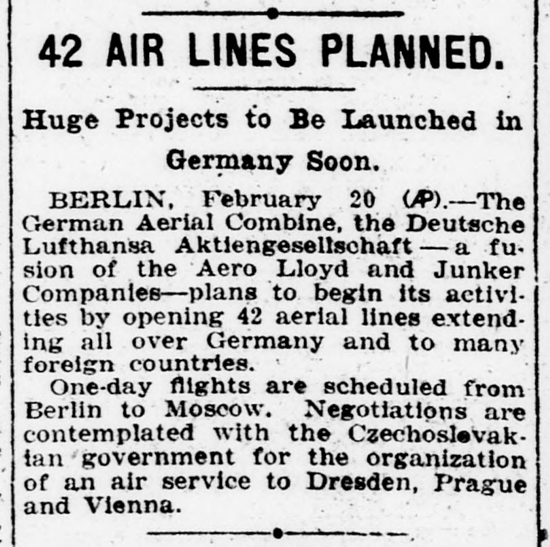
Luft Hansa, newspaper announcement 1926
Luft Hansa, newspaper announcement (Evening star, Washington, D.C., February 21, 1926). «42 AIR LINES PLANNED. Huge Projects to Be Launched in Germany Soon. BERLIN, February 20 - The German Aerial Combine, the Deutsche Lufthansa Aktiengesellschaft - a fusion of the Aero Lloyd and Junker Companies - plans to begin its activities by opening 42 aerial lines extending all over Germany and to many foreign countries. One-day flights are scheduled from Berlin to Moscow. Negotiations are contemplated with the Czechoslovakian government for the organization of an air service to Dresden, Prague and Vienna».

Lufthansa, first flight, April 6, 1926
Luft Hansa, the first ever scheduled flight (April 6, 1926), from Berlin to Zürich via Halle, Erfurt and Stuttgart, Fokker-Grulich F II aircraft.

Lufthansa 1926
Lufthansa passenger 1926
Luft Hansa, Fokker-Grulich F II aircraft (1926)

Lufthansa poster 1926
Luft Hansa poster "Fliegt in die Bäder" ("Fly to the beaches", 1926  by Hans Vogel)

Lufthansa poster 1927
Luft Hansa poster "Fliegt in die Bäder!" ("Fly to the beaches!", 1927 by Hans Vogel)

Lufthansa 1928
Luft Hansa, passengers and airfreight had to be weighed (photo 1928)

Lufthansa poster 1932
Luft Hansa poster (1932 by Otto Arpke)

Lufthansa founders 1953
Luftag refounders on the company's first day (January 6, 1953): from left, Chairman Hans M. Bongers, Federal German Minister of Transport Hans-Christoph Seebohm, Technical Director Gerhard Höltje, and Chairman of the Supervisory Board Dr. Kurt Weigelt.

Lufthansa crew 1955
Lufthansa, the first cabin crew members (February 1955) were ready for flight operations; they started work with route proving flights in March.

Lufthansa stamps 1955
Lufthansa, four commemorative stamps (March 31, 1955) issued to mark the post-war re-establishment of Lufthansa Airlines and the resumption of domestic and international flights.

Lufthansa timetable 1955 - front
Lufthansa timetable 1955 - back
Lufthansa, first timetable (April 1, 1955)

Lufthansa first flight from Hamburg 1955
Lufthansa, the first two flights operated by the new company (April 1, 1955): two Convairs CV-340 took off almost simultaneously in Hamburg (photo above) and Munich (below), for a day of regular scheduled services.
Lufthansa first flight from Munich 1955

Lufthansa 60th Anniversary 2015
Lufthansa celebrate 60 years (april 1955-2015). To honor their 60th Anniversary, Lufthansa had "Yankee Tango" (Boeing 747-8 D-ABYT, above) painted in a livery that resembled what the 747 fleet looked like in the 1970s when Lufthansa began flying 747-100 and -200 variants.