Nestlé


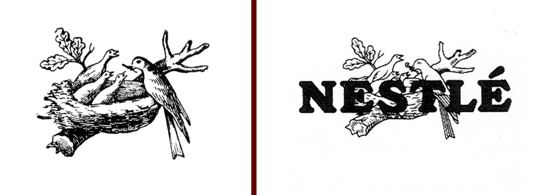
Nestlé logo 1868 - 1938
Nestlé logo 1868 (left) and 1938 (right). Henri Nestlé used his family's crest (Nestlé = little nest in German) as inspiration for the brand; later, lettering and logo were combined to become the unifying distinguishing mark for different Nestlé products.

Henri Nestlé
Henri Nestlé (Frankfurt, Aug. 10, 1814 - Montreux, July 7, 1890), confectioner, inventor of the "Farine Lactée Nestlé" and founder of the Nestlé company
Name: "Farine Lactée Nestlé"

Category: Food

Subcategory: Baby food

Inventor: Henri Nestlé

Invented: 1867 - Vevey, Switzerland

Producer: "Anglo-Swiss Condensed Milk Company" (founded by Charles Page and George Page in 1866 - Cham, Switzerland), merged in 1905 with "Société Farine Lactée Henri Nestlé" (founded by Henri Nestlé on March 8, 1875 - Vevey, Switzerland, under new ownership) to become "Nestlé and Anglo-Swiss Condensed Milk Company".

Production start: 1867 - Vevey, Switzerland

Features: Farine Lactée Nestlé was a mixture of cow's milk, wheat flour and sugar, for consumption by infants who could not be breastfed. The German-Swiss pharmacist Henri Nestlé invented this formula to combat the raging infant mortality prevalent at the time, in close cooperation with his friend Jean Balthasar Schnetzler, a Swiss naturalist. His model was Justus von Liebig, a German scientist who at that time developed a soluble food for babies: «Liebig first kindled the flame of truth about human nutrition. He also drew up the requirements for his infant paste. It is an excellent product but far too difficult to prepare, requiring as it does half an hour of complicated cookery. Furthermore, the mother had to obtain the finest quality flour, malt, milk, and potash, which is certainly no small task. (...) My product is prepared entirely on Liebig's principles, only I reach the same goal by other means» (Henri Nestlé, 1868). Ready to use, Farine Lactée Nestlé needed only to be boiled prior to feeding; thus, it soon proved to be a viable substitute for breast milk for infants who were unable to be breastfed.
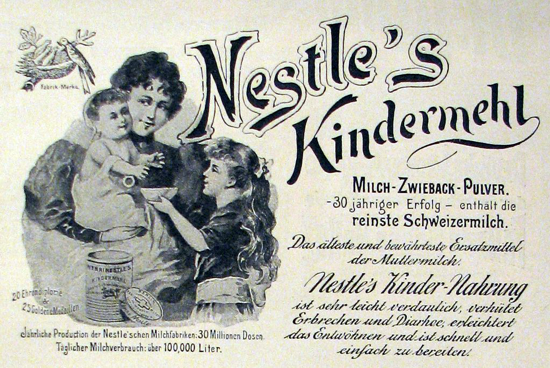
Nestlé's name appeared in advertisements and on labels in association with the name of the product: "Farine Lactée Nestlé" in French, "Nestlé's (Milk) Food" (USA and Australia), "Nestlé's Bread and Milk Flour" (Britain), "Harina Lacteada Nestlé" (Spain), "Nestlé's Kindermehl" (Germany).

Interesting facts: In 1866 the Anglo-Swiss Condensed Milk Company was established in Cham, Switzerland, by the American brothers George and Charles Page, to market their "Milkmaid" condensed milk as a safe, long-lasting alternative to fresh milk. In 1867 Henri Nestlé developed his "Farine Lactée", and soon began marketing it as baby food for consumption by infants who cannot be breastfed. In 1905 this two companies, after years of fierce competition during which both selling rival versions of the other's original products (condensed milk and infant cereal), merge to form the Nestlé and Anglo-Swiss Milk Company. Before this, in 1875, Henri Nestlé retired and sold his company to his business associates, but the company retained his name as Société Farine Lactée Henri Nestlé; by the same year, Nestlé's products were sold everywere from Indonesia to Egypt, and from the US to Argentina. When Nestlé and Anglo-Swiss merged in 1905, the company had more than 20 factories, and started using overseas subsidiaries to establish a sales network that included Africa, Asia, Latin America and Australia; over 150 years since its foundation, Nestlé results the largest food company in the world, with a range of products including baby food, medical food, bottled water, breakfast cereals, coffee and tea, confectionery, dairy products, ice cream, frozen food, pet foods, snacks...

Quote (Henri Nestlé, 1878): «My invention is not a new discovery but a correct and rational application of substances long known to be the best for the feeding of children. The chief ingredients are quality milk, bread and sugar».

Property: Nestlé S.A.

Official website: https://www.nestle.com

Nestlé advertisement 1872
Nestlé newspaper advertisement (Evening star, Washington, D.C., March 25, 1872). «MOTHERS, SAVE YOUR INFANTS. NESTLE'S LACTEOUS FARINA, THE MOTHER'S MILK SUBSTITUTE. Extensively used and recommended by the most eminent physicians. Sold by Druggist and Fine Grocers. B.W. REED & SONS, Agents for the South, 1214 F street northwest, Washington, D.C. Send for memorial on the Nutrition of Infants, by Henri Nestlé, Chemist. Furnished gratis. m20 12t».

Nestlé advertisement 1880
Nestlé newspaper advertisement (Chicago daily tribune, Chicago, Ill., July 13, 1880). «NESTLE'S MILK FOOD. Manufactured solely by Henry Nestlé, Vevey, Switzerland. Contains only milk, wheaten bread-crust, and sugar, and requires only water to prepare it for use. Recommended by all family physicians as a certain preventive of cholera infantum and summer complaints. Pamphlets with full particulars sent to any address. Kept by druggist and grocers. Thomas Lemming & Co., Montreal, Canada».

Nestlé advertisement 1882
Nestlé advertisement 1888
Nestlé newspaper advertisements (Boletín mercantil de Puerto Rico, San Juan, P.R.; top: January 25, 1882 / bottom: March 4, 1888)

Nestlé factory 1890
Nestlé factory in Vevey, Switzerland (ca. 1890)

Nestlé milk arrival 1890
Nestlé milk arrival in Cham, Switzerland (ca. 1890)

Nestlé tins 1875 - 1890
Farine Lactée Nestlé, early tins (German packaging, left ca. 1875, right ca. 1890)

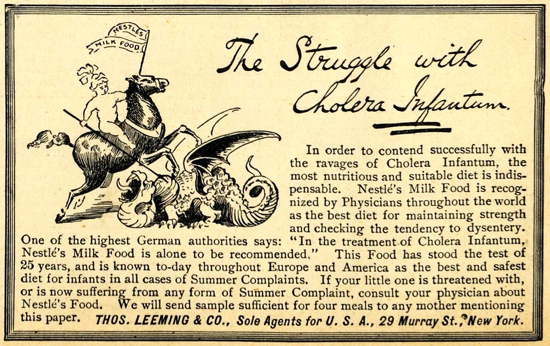
Nestlé advertisement 1891
Nestlé advertisement (1891): «The Struggle with Cholera Infantum»

Nestlé advertising 1893
Nestlé advertising (1893)

Nestlé advertising 1897
Nestlé advertising (1897, art by Alphonse Mucha)

Nestlé advertisement 1898
Nestlé advertisement (Illustrirte Zeitung Leipzig und Berlin, August 11, 1898)

Nestlé advertisement 1900
Nestlé advertisement (Paris-Noël, December 1900): «Farine Lactée Nestlé, 30 ans de succès»

Nestlé 150th Anniversary 1866-2016
Nestlé celebrates 150 years (1866-2016) with a series of events around the world, and inaugurating its "Nest" (June 2, 2016), an interactive Museum in Vevey, the Swiss city where the first factory was built.

Heineken


Heineken label 1954
Heineken label 1954
Name: "Heineken"

Category: Drink

Subcategory: Beer

Producer: Heineken's Bierbrouwerij Maatschappij NV (founded by Gerard Adriaan Heineken in Amsterdam on February 15, 1864)

Production start: 1873 - Amsterdam, Holland

Original recipe: Since its origins, Heineken beer is brewed in a natural brewing process, with no additives. It contains water, barley malt, hops and the unique Heineken A-yeast for the fermentation.

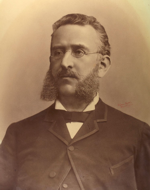
Gerard Adriaan Heineken
Amsterdam, Sept. 28, 1841
- March 18, 1893,
founder of Heineken & Co.
Interesting facts: On February 15, 1864, Gerard Adriaan Heineken bought De Hooiberg (The Haystack), an old brewery and well-known Amsterdam establishment dating from 1592.
In 1869 Gerard Heineken decided to switch from traditional top fermentation to the Bavarian method of bottom fermentation, a totally different technique that produces a clearer, purer beer, which keeps longer.
On January 11, 1873, Heineken's Bierbrouwerij Maatschappij NV (HBM) was established, and Gerard Heineken was appointed President.
A second brewery was opened in Rotterdam in 1874.
In 1886 Dr. Hartog Elion, a pupil of the French chemist Louis Pasteur, developed the "A-yeast" in the Heineken laboratory. This yeast is still the key ingredient of Heineken beer.

Quote (Gerard Heineken): «A good product is recommended by its use alone»

Property: Heineken N.V.

Product website: http://www.heineken.com

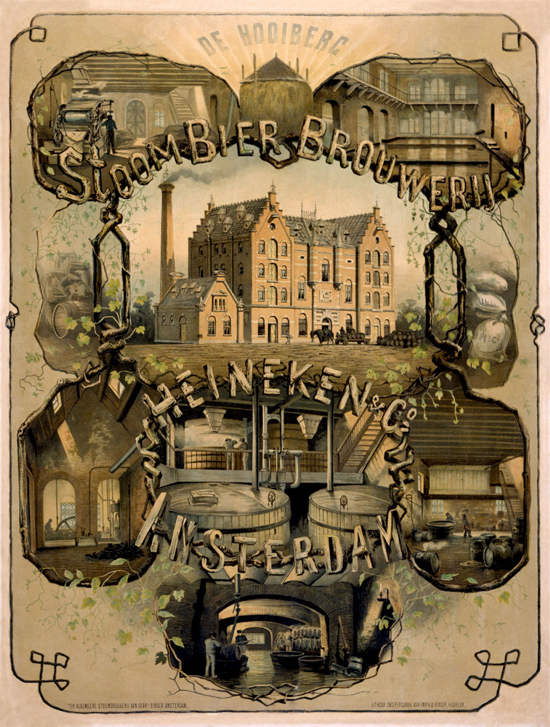
Heineken brewery in Amsterdam, 1867
Heineken, the Amsterdam brewery (1867)

Heineken labels 1870s
Heineken, early labels from the 1870 "Beiersch" beer

Heineken ad 1870s
Heineken, advertisement for De Hooiberg (The Haystack), by C. Greive (ca. 1870)

Heineken labels 1880-90s
Heineken, early labels with the distinctive five point star and green color. Over the years, the names of prizes won by Heineken have been added to the label: a gold medal at the International Exposition in Paris in 1875, the "Diplome d'Honneur" in Amsterdam in 1883, followed by the "Grand Prix" at the 1889 World's Fair in Paris.

Heineken ad 1890s
Heineken, advertisement for Export beer (ca. 1890)

Heineken drays 1900s
Heineken lorry 1900s
Heineken, two horse-drawn drays and one of the first lorries (ca. 1900)

Heineken price list 1900s
Heineken, price list from Die Port van Cleve Hotel (early 1900s)

Early Heineken beer bottle
Heineken, an early beer bottle

Heineken 150th anniversary
Heineken celebrates its 150th Anniversary (1864-2014). To commemorate 150 years of Heineken's existence, in 2014 three of the brewery's landmark historical buildings were reproduced in handmade ceramic miniatures, as a gift for all employees of Heineken worldwide.

Pepsi-Cola


Pepsi-Cola logo 1898
Original name: "Brad's Drink" (1893)

Name: "Pepsi-Cola" (August 28, 1898)

Category: Drink

Subcategory: Soft drinks

Inventor: Caleb Bradham

Producer: Pepsi-Cola Company
(founded by Caleb Bradham in 1902)

Caleb Bradham
Caleb Bradham
Chinquapin, May 27, 1867
- New Bern, Feb. 19, 1934,
pharmacist and
inventor of Pepsi-Cola
Production start: 1898 (1893 as "Brad's Drink") - New Bern, North Carolina, USA

First price: It was initially sold as a refreshing - aiding in digestion drink for five cents a glass at soda fountains

Original recipe: Carbonated water, sugar, vanilla, rare oils and cola nuts

Interesting facts: In 1893 pharmacist Caleb Bradham invented the "Brad's Drink", a refreshing drink sold at soda fountains in his drugstore in New Bern, North Carolina. In 1898 he renamed it "Pepsi-Cola"; Cola is a term based on the African kola nut, and Pepsi comes from pepsin, an enzyme which aids in digestion and was also a popular ingredient in early soft drinks and chewing gum. In 1902, he launched the Pepsi-Cola Company in the back room of his pharmacy; the business began to grow, and on June 16, 1903, "Pepsi-Cola" became an official trademark. By 1904, the Pepsi-Cola Syrup sales reached almost 20,000 gallons. As demand for the drink continued to rise, Bradham decided it was time to offer Pepsi-Cola in bottles. By 1910 there were 240 franchises in 24 states and that year the Pepsi-Cola Company held their first Bottler Convention in New Bern. The outbreak of World War I changed the U.S. financial landscape, and the cost of doing business increased drastically. Sugar prices fluctuated wildly between record highs and disastrous lows, and so did the cost of producing Pepsi-Cola. In 1923, Pepsi-Cola was bankrupt. Caleb returned to his pharmacy and sold the valuable Pepsi-Cola trademark to Craven Holdings Corporation, the first of what would be several owners.

Slogan (1902): «PEPSI-COLA is healthful, refreshing, invigorating and delicious. Aids digestion»

Property: PepsiCo Inc.

Product website: http://www.pepsi.com

Caleb Bradham pharmacy
Caleb Bradham (circled) serving Pepsi-Cola in his pharmacy (1900s)

Pepsi-Cola ad 1902
Pepsi-Cola newspaper advertisement (Goldsboro weekly argus, Goldsboro, N.C., November 27, 1902). «PEPSI-COLA is healthful, refreshing, invigorating and delicious. Aids digestion. 5 cts. at soda fountains».

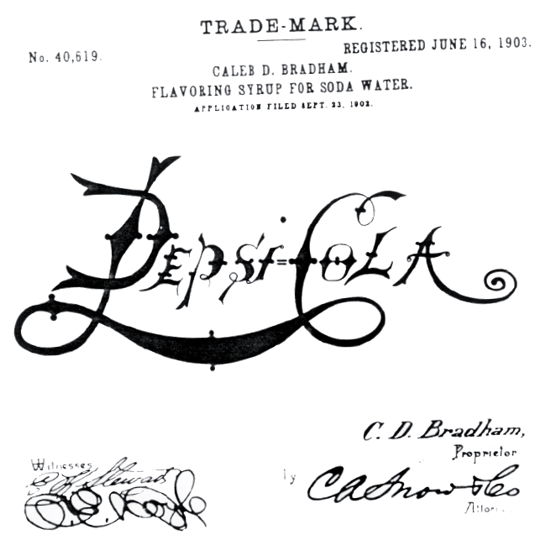
Pepsi-Cola trademark 1903
Pepsi-Cola trademark granted to Caleb Bradham (June 16, 1903)

Pepsi-Cola ad 1903
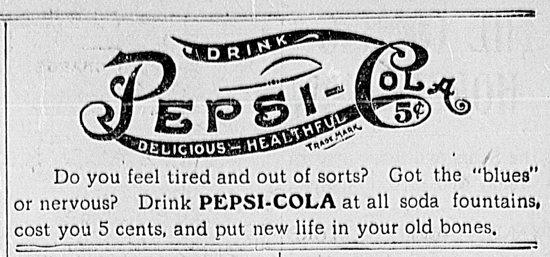
Pepsi-Cola newspaper advertisement (The times dispatch., Richmond, Va., August 7, 1903). «Do you feel tired and out of sorts? Got the "blues" or nervous? Drink PEPSI-COLA at all soda fountains, cost you 5 cents, and put new life in your old bones».

Pepsi-Cola ad 1907
Pepsi-Cola newspaper advertisement (The times dispatch., Richmond, Va., September 17, 1907). «Put Down Your Bundles and Take a Rest»

Pepsi-Cola ad 1908
Pepsi-Cola newspaper advertisement (The times dispatch., Richmond, Va., June 30, 1908). Automobile race pioneer Barney Oldfield was the first celebrity to endorse Pepsi-Cola.

Pepsi-Cola poster 1905-1910
Caleb Bradham's daughter, Mary, poses with an early Pepsi poster (c. 1905-1910)

Pepsi-Cola postcard 1907-1913
Pepsi-Cola postcard 1907-1913, detail
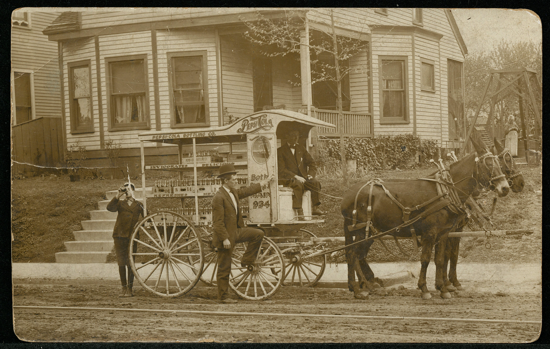
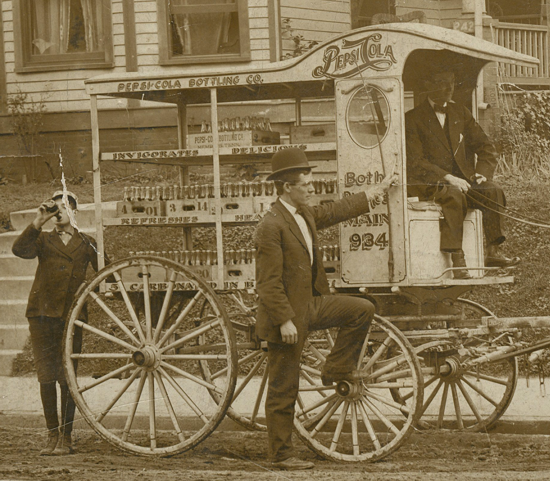
Postcard of a mule-drawn Pepsi Cola delivery wagon (c. 1907-1913)

Pepsi-Cola 12-ounce bottle
Pepsi-Cola six-pack
Pepsi-Cola, 12-ounce bottle and six-pack (1930s)

Pepsi-Cola early cans
Pepsi-Cola, early cans (left 1948, center 1950, right 1959)

Pepsi-Cola 2014
Pepsi-Cola, advanced versions (2014)

Kellogg's


Kellogg's logo 1907
Kellogg's logo 1907
Original name: "Sanitas Toasted Corn Flakes" (1906)

Name: "Kellogg's Toasted Corn Flakes" (1907)

Category: Food

Subcategory: Cereal

Inventors: Dr. John Harvey Kellogg and his brother Will Keith Kellogg

Invented: August 8, 1894 - Battle Creek Sanitarium, Michigan, USA

Producer: Battle Creek Toasted Corn Flakes Company (founded by Will Keith Kellogg on February 19, 1906)

Production start: 1906 - Battle Creek, Michigan, USA

First price: In 1906, a large package of Sanitas Toasted Corn Flakes cost 10 cents

Features: Corn flakes are a packaged cereal product formed from small toasted flakes of corn, and are usually served cold with milk and sugar. The cereal was created by Dr. John Harvey Kellogg and patented in 1896. In the patent, processing the product was described as follows.
«First. Soak the grain for some hours - say eight to twelve - in water at a temperature which is either between 40° and 60° Fahrenheit or 110° and 140° Fahrenheit, thus securing a preliminary digestion by aid of cerealin, a starch-digesting organic ferment contained in the hull of the grain or just beneath it. The temperature must be either so low or so high as to prevent actual fermentation while promoting the activity of the ferment. This digestion adds to the sweetness and flavor of the product.
Second. Cook the grain thoroughly. For this purpose it should be boiled in water for about an hour, and if steamed a longer time will be required. My process is distinctive in this step - that is to say, that the cooking is carried to the stage when all the starch is hydrated. If not thus thoroughly cooked, the product is unfit for digestion and practically worthless for immediate consumption.
Third. After steaming the grain is cooled and partially dried, then passed through cold rollers, from which it is removed by means of carefully-adjusted scrapers. The purpose of this process of rolling is to flatten the grain into extremely thin flakes in the shape of translucent films, whereby the bran covering (or the cellulose portions thereof) is disintegrated or broken into small particles, and the constituents of the grain are made readily accessible to the cooking process to which it is to be subsequently subjected and to the action of the digestive fluids when eaten.
Fourth. After rolling the compressed grain or flakes having been received upon suitable trays is subjected to a steaming process, whereby it is thoroughly cooked and is then baked or roasted in an oven until dry and crisp.
The finished product thus consists of extremely thin flakes, in which the bran (or the cellulose portions thereof) is disintegrated and which have been thoroughly cooked and prepared for the digestive processes by digestion, thorough cooking, steaming, and roasting. In this respect it differs from any similar alimentary article which has been heretofore produced».

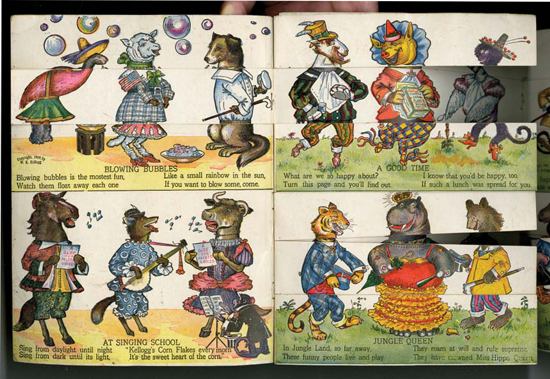
Interesting facts: In the late 19th century, a team of Seventh-day Adventists began to develop new food to adhere to the vegetarian diet recommended by the church. Members of the group experimented with a number of different grains, including wheat, oats, rice, barley, and corn. In 1894, Dr. John Harvey Kellogg, the superintendent of The Battle Creek Sanitarium in Michigan and an Adventist, used these recipes as part of a strict vegetarian regimen for his patients. On August 8, 1894, Dr. John Harvey Kellogg and his younger brother, Will Keith Kellogg, decided to process some cooked wheat by forcing it through rollers, hoping to obtain long sheets of the dough. To their surprise, what they found instead were flakes, which they toasted and served to their patients. A patent for the product was filed on May 31, 1895, and issued on April 14, 1896. The brothers then experimented with other flakes from other grains. In 1906, Will Keith Kellogg, who served as the business manager of the sanitarium, decided to try to mass-market the new food. At his new company, Battle Creek Toasted Corn Flake Company, founded on February 19, he added sugar to the flakes to make them more palatable to a mass audience, but this caused a rift between his brother and him. To increase sales, in 1909, he added a special offer, the Funny Jungleland Moving Pictures Booklet (patented on January 15, 1907), which was originally made available to anyone who bought two boxes of the cereal, and then changed to a premium mail-in offer for the cost of a dime. The book was distributed in different editions over a period of 23 years. At the same time, Kellogg also began experimenting with new grain cereals to expand his product line. Rice Krispies, his next great hit, first went on sale in 1928.
In 2012, Kellogg's became the world's second-largest snack food company by acquiring the Pringles potato crisps brand from Procter & Gamble.

Slogan (1906): «Wins It's Favor Through It's Flavor». «The Flavor that Grows in Favor». «The Way to Your appetite». «A Breakfast Treat That Makes You Eat». «Toasted Corn Flakes Make Him Grow». «Lost Appetites Found Toasted Corn Flakes». «Light as Driven Snow». «The Irresistible Food».

Property: Kellogg Company

Official website: http://kelloggs.com

Battle Creek Sanitarium, Health Foods advertising 1897
Battle Creek Sanitarium, Health Foods advertisement (1897)

Battle Creek Toasted Corn Flakes, advertising 1903-1905
Battle Creek Toasted Corn Flakes, advertisements. Left: The Evening World newspaper (New York, July 28, 1903). Right: The Minneapolis journal (Minneapolis, May 11, 1905).

Sanitas Toasted Corn Flakes, first package 1906
Sanitas Toasted Corn Flakes, first package (1906)

Sanitas Toasted Corn Flakes, advertising Sept. 1, 1906
Sanitas Toasted Corn Flakes, advertisement. Rock Island Argus newspaper (Rock Island, Ill., Sept. 1, 1906).

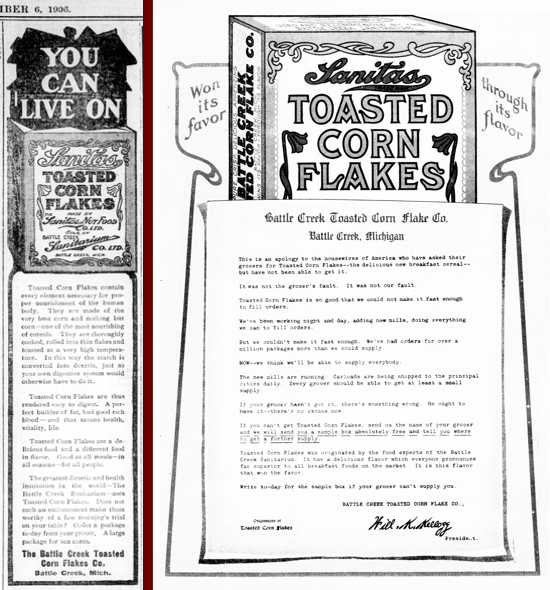
Sanitas Toasted Corn Flakes, advertising Sept. 6, 1906
Sanitas Toasted Corn Flakes, advertisements. Left: Rock Island Argus newspaper (Rock Island, Ill., Sept. 6, 1906). Right: New-York Tribune (Sept. 6, 1906).

Sanitas Toasted Corn Flakes, advertising Sept. 11, 1906
Sanitas Toasted Corn Flakes, advertising Sept. 15, 1906
Sanitas Toasted Corn Flakes, advertising Sept. 29, 1906
Sanitas Toasted Corn Flakes, advertising Oct. 4, 1906
Sanitas Toasted Corn Flakes, advertising Oct. 6, 1906
Sanitas Toasted Corn Flakes, advertisements. Rock Island Argus newspaper (Rock Island, Ill., 1906, from top: Sept. 11-15-29, Oct. 4-6).

Sanitas Toasted Corn Flakes, advertising Oct. 11-16-23, 1906
Sanitas Toasted Corn Flakes, advertisements. The Minneapolis journal (1906, anticlockwise from top: Oct. 11-16-23).

Sanitas Toasted Corn Flakes, advertising 1907
Sanitas Toasted Corn Flakes, advertisement with Will Keith Kellog's portrait and signature. Rock Island Argus newspaper (Rock Island, Ill., May 2, 1907).

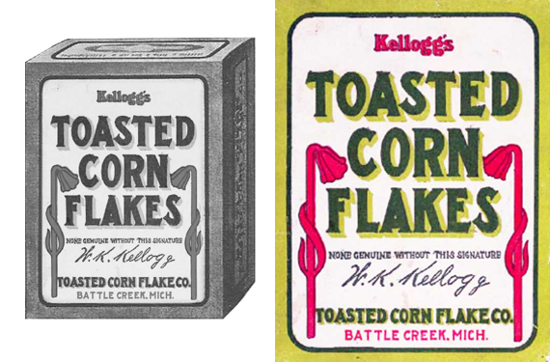
Kellogg's Toasted Corn Flakes, first package 1907
Kellogg's Toasted Corn Flakes, first package with "Kellogg's" instead of "Sanitas" (1907)

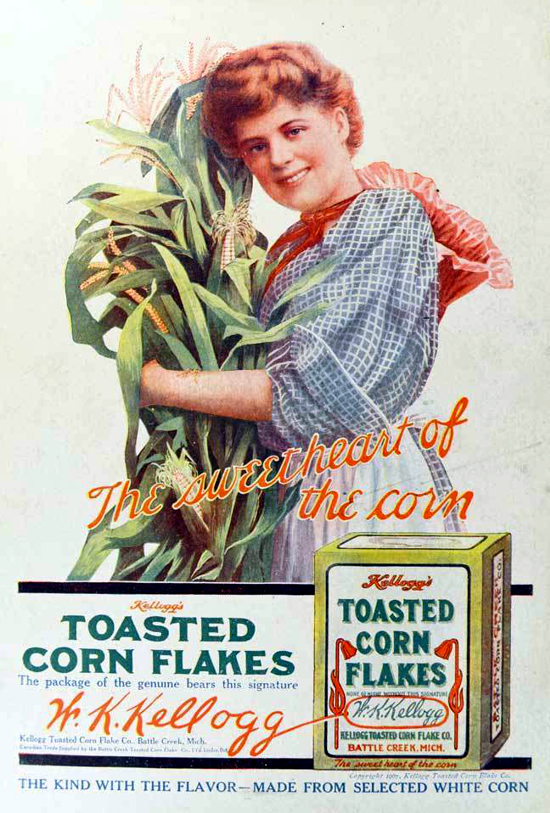
Kellogg's Toasted Corn Flakes, advertising 1907
Kellogg's Toasted Corn Flakes, advertisement. The sun (New York, June 26, 1907).

Kellogg's Toasted Corn Flakes, advertising with new logo 1907
Kellogg's Toasted Corn Flakes, new logo 1907
Kellogg's Toasted Corn Flakes, advertisement and new logo with the big "K" which became the distinctive brand (1907)

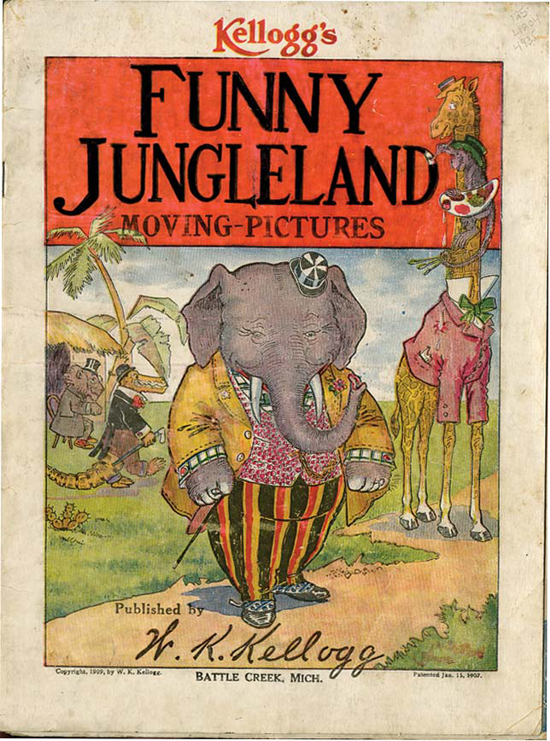
Kellogg's, Funny Jungleland Moving Pictures Booklet advertising 1909
Kellogg's, Funny Jungleland Moving Pictures Booklet 1909
Kellogg's, Funny Jungleland Moving Pictures Booklet - inside - 1909
Kellogg's, Funny Jungleland Moving Pictures Booklet: advertisement and book (1909). Patented on January 15, 1907, it was originally made available to anyone who bought two boxes of the cereal, and then changed to a premium mail-in offer for the cost of a dime. The interior pages are cut into six flaps so that the reader, by turning the flaps, can change the composition of the pictures. Each half page contains three pictures of costumed animals at various activities. The book was distributed in different editions over a period of 23 years (last edition was published in 1932).

The Kellogg brothers. Dr. John Harvey Kellogg and Will Keith Kellogg
The Kellogg brothers. Dr. John Harvey Kellogg (Tyrone, Feb. 26, 1852 - Battle Creek, Dec. 14, 1943), medical doctor and inventor of the corn flakes, and Will Keith Kellogg (Battle Creek, Apr. 7, 1860 - Oct. 6, 1951), industrialist and founder of the Kellogg Company.

Kellogg's 120th Anniversary
Kellog's celebrates its 120th Anniversary (February 19, 1906-2026)