Wikipedia


Wikipedia logo 2001
Wikipedia logo 2001
Name: "Wikipedia"

Category: Internet

Subcategory: Online encyclopedias

Registered:
--- January 12, 2001 (wikipedia.com)
--- January 13, 2001 (wikipedia.org)

Official release: January 15, 2001

Developers / Founders:
--- Jimmy Wales
--- Larry Sanger

Programming languages: LAMP platform (Linux, Apache, MySQL, PHP)

Features: Wikipedia is a free online encyclopedia with the aim to allow anyone to edit articles. The name "Wikipedia" is a portmanteau of "wiki" (software that provides collaborative modification of its content and structure directly from the web browser) and "encyclopedia". Wikipedia was initially conceived as a feeder project for the Nupedia, a free online encyclopedia born ten months earlier.
The idea of creating a publicly editable encyclopedia without an editorial process (unlike Nupedia), combined with the new strategy of using the wiki platform, was the key to its success. In January 2001 Wikipedia was launched as a single English-language, and its early contributors came from Nupedia, Slashdot postings, and web search engine indexing. Early in Wikipedia's development, it began to expand internationally, with the creation of new namespaces, each with a distinct set of usernames. The first subdomain created for a non-English Wikipedia was "deutsche.wikipedia.com" (March 16, 2001). By the end of 2001, Wikipedia had grown to approximately 20,000 articles and 18 language editions.

Interesting facts: In 1996, American internet entrepreneurs Jimmy Wales (later Wikipedia's co-founder), Tim Shell, and Michael Davis founded Bomis, a web-advertising portal. In 2000 Jimmy Wales hired Larry Sanger (later second Wikipedia's founder), a graduate philosophy student, to help him develop the first project about a free online encyclopedia built by volunteers: Nupedia went online in March of that year, supported by Bomis' resources. Nupedia was characterized by an extensive peer-review process, designed to make its articles of a quality comparable to that of professional encyclopedias; so Wales and Sanger discussed various ways to create content more rapidly. A computer programmer named Ben Kovitz suggest Sanger to introduce the so-called "wiki" platform, a software that allows publishers to contribute simultaneously and incrementally. In five days: this new project was proposed on the Nupedia mailing list, Sanger gave it a name, domain names ".com" and ".org" were registered, and on Monday 15 January 2001 Wikipedia was formally announced. Two days later an appeal for volunteers to engage in content creation was made by Sanger to the Nupedia mailing list, and the project began to receive its first participants.

Slogan (2001): «The Free Encyclopedia"

Property: Wikimedia Foundation, Inc.

Website: https://www.wikipedia.org

Nupedia announces Wikipedia
Wikipedia, first announcement on the home page of its predecessor Nupedia (January 17, 2001). «Finally, we'd like to announce a fun project loosely associated with Nupedia, Wikipedia. Have a look and write a paragraph or two!» Nupedia, launched on March 9, 2000, had a seven-step approval process to control content of articles before being posted, rather than live wiki-based updating, and authors were expected to have expert knowledge. Before it ceased operating (September 26, 2003), only 25 articles were approved and published.

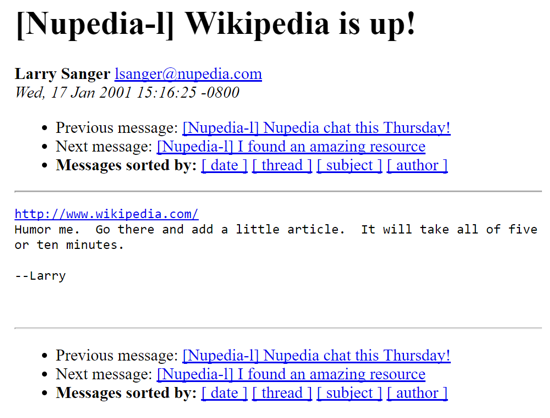
Larry Sanger announces Wikipedia
Wikipedia, announcement by co-founder Larry Sanger on Nupedia mailing list (January 17, 2001): «Wikipedia is up! http://www.wikipedia.com Humor me. Go there and add a little article. It will take all of five or ten minutes. --Larry».

Wikipedia, first home page 2001
Wikipedia, first home page (screenshot March 31, 2001). Eleven weeks after launch, the introduction reads: «Welcome to Wikipedia! We're writing a complete encyclopedia from scratch, collaboratively. We started work in January 2001. We've got over 3,000 pages already. We want to make over 100,000. So, let's get to work! Write a little (or a lot) about you know!»

Wikipedia, first two logos 2001
Wikipedia, first two logos (2001, left January, right December). Wikipedia's first logo was an image that was originally submitted by Bjørn Smestad for a Nupedia logo competition which took place in 2000. The logo included a quote from the preface of "Euclid and his Modern Rivals" by Lewis Carroll. The second logo was chosen in the first Wikipedia logo contest, which took place from November to December 2001, from a list of 24 leading candidates: the winner was an image contributed by user The Cunctator, which included a quote from Thomas Hobbes's "Leviathan", Part I, Chapter VI. This second logo was adopted from December 12, 2001 to September 26, 2003, when the English Wikipedia switched to Paul Stansifer's contest-winning "puzzle ball" logo.

Wikipedia second logo 2001
Wikipedia, header with new logo (December 12, 2001 - «over 18,000 articles»)

Jimmy Wales and Larry Sanger
Wikipedia founders: Jimmy Donal "Jimbo" Wales (Huntsville, August 7, 1966) and Lawrence Mark "Larry" Sanger (Bellevue, July 16, 1968)

English Wikipedia reaches 5,000,000 articles in 2015
English Wikipedia celebrates five million articles (November 1, 2015)

Wikipedia 20th anniversary 2021
Wikipedia celebrate their 20th anniversary (2001-2021)

Amazon


Amazon logo 1995
Amazon logo 1995
Names:
--- "Cadabra" (reg. July 5, 1994)
--- "Relentless" (reg. Sept. 25, 1994)
--- "Amazon" (reg. Nov. 1, 1994)

Category: Internet

Subcategory: Electronic commerce

Founder: Jeff Bezos

Founded: July 5, 1994 (as "Cadabra")

Place of develop: Bellevue, Washington, USA

Public release: July 16, 1995

Programming languages: C++, Java

Features: Amazon started off as an online bookstore in 1994, and opened to the public in 1995. In 1998 Amazon expanded beyond books: on April 27, it announces the acquisition of three leading Internet companies: Bookpages, Ltd (English online bookstore); Telebook, Inc. (German online bookstore); and Internet Movie Database Ltd. (movie and TV archive); on August 4, it announces the acquisition of PlanetAll (online address book and calendar service), and Junglee Corporation, which operates a service that lets people shop for everything, from clothing to computers. This were just the first of a long series of wide-ranging investments. In late 2015 Amazon reported that it had more than 270 million active customer accounts worldwide, and was shipping to more than 75 countries.

Interesting facts: In 1994, Jeff Bezos left his employment as vice-president of D. E. Shaw & Co., a Wall Street firm, and moved to Seattle. On July 5 he founded "Cadabra", an online bookstore. The company was renamed "Relentless" in September, then went officially online as Amazon.com on July 16, 1995.

Slogan (1995): «Earth's biggest bookstore»

Property: Amazon.com, Inc.

Website: http://amazon.com

Amazon development
Amazon development: Jeff Bezos advertised for the first employees via Usenet (August 21, 1994). «Well-capitalized Seattle start-up seeks Unix developers (...) US mail: Cadabra, Inc.»

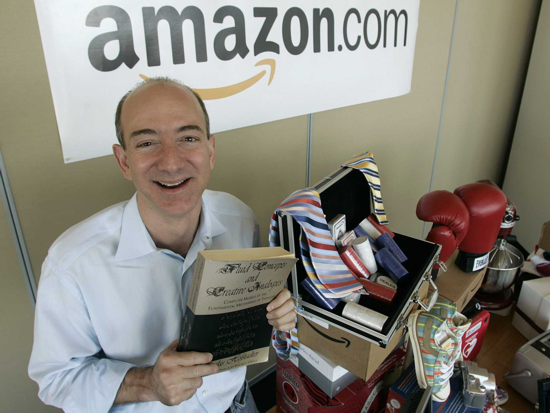
The first book purchased on Amazon
The first book purchased on Amazon.com with its packing slip (April 3, 1995). During a beta test for the new service, Amazon.com sold its first book, "Fluid Concepts & Creative Analogies: Computer Models of the Fundamental Mechanisms of Thought" by Douglas Hofstadter, to the first customer John Wainwright, an Australian software engineer based in Sunnyvale, California.

Amazon home page 1995
Amazon.com in 1995: one million book titles

Amazon first announcement
Amazon.com officially announces itself to the public (October 4, 1995). «World's Largest Bookseller Opens on the Web - http://www.amazon.com/ - Amazon.com, the business and domain name of the most voluminous new retailer on the Internet, has thrown open its virtual doors to offer the largest collection of books in the world to anyone with World Wide Web access. The Seattle-based company currently offers more than one million different titles, 40 times more than typical mall bookstores, and more than 5 times as many as the country's largest book superstores. The retailer can be found at http://www.amazon.com/».

Amazon home page 1996
Amazon.com in 1996, 2.5 Million Titles: 1.5 Million Books in Print & 1 Million Out-of-Print

Amazon October 1998
Amazon November 1998
Amazon.com in 1998 expands beyond books by adding Music (top, screenshot October 7) and Video (bottom, screenshot November 18)

Amazon home page 1999
Amazon.com in 1999 (screenshot August 27)

Jeff Bezos
Jeffrey Preston "Jeff" Bezos (Albuquerque, January 12, 1964), the American entrepreneur who founded Amazon.com, Inc.

Amazon Prime Day 2015
Amazon marks its 20th anniversary (July 16, 2015) by launching the "Amazon Prime Day", featuring special deals for prime members

YouTube


YouTube logo 2005
YouTube logo 2005
Name: "YouTube"

Category: Internet

Subcategory: Video-sharing

Registered: February 14, 2005

Beta release: May 2005

Official release: December 15, 2005

Developers / Founders: Chad Hurley, Steve Chen, Jawed Karim

Place of develop: San Mateo, California, USA (first headquarters)

Programming languages: Java, Python, JavaScript

Features: The first version of the video-sharing service Youtube was totally free. Registration offered: uploading videos in .AVI, .MOV, and .MPG file formats, less than 100 MB in size, without limitation as to time and amount; tags; links and embeddable players for single videos or playlists; managing favorites, profile and friends; channels with subscriptions.

Interesting facts: YouTube was founded by Chad Hurley, Steve Chen, and Jawed Karim. Chad Hurley had studied design at Indiana University in Pennsylvania, while Steve Chen and Jawed Karim had studied computer science at the University of Illinois at Urbana-Champaign. After graduation, they started work at PayPal in San Jose, California where they met many of their future employees. As content and photo sharing sites were taking off in 2005, the founders of YouTube noticed a small problem: there was an explosion in the number of expensive and inexpensive ways to capture video but there wasn't a good way to share videos. On February 14, 2005, Hurley registered the trademark, logo and domain of YouTube. On April 23, the first video, featuring co-founder Jawed Karim, was uploaded to the site. It was titled "Me at the Zoo". In May, a small group of early employees launched the beta test site www.youtube.com. The first video to reach one million views was a Nike advertisement featuring Ronaldinho in September. In November, YouTube received funding from Sequoia Capital. On December 15, 2005, YouTube officially became a corporation, by which time the site was receiving 8 million views a day. Google acquired YouTube on October 6, 2006, and the deal was finalized on November 13 for $1.65 billion in Google stock.

Slogan (2005): «Broadcast Yourself»

Property: YouTube, LLC - Google Inc.

Website: https://www.youtube.com

Youtube beta test 2005
YouTube, beta test homepage (retrieved April 28, 2005). The original idea for YouTube was a video version of an online dating service.

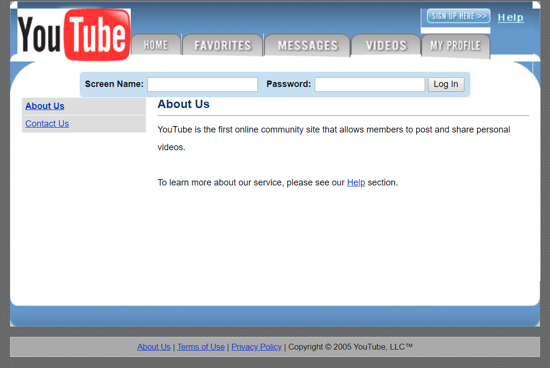
Youtube about page April 2005
YouTube, beta test about page (retrieved April 28, 2005). «YouTube is the first online community site that allows members to post and share personal videos».

YouTube, first video uploaded (April 23, 2005). Duration: 0:19. Uploaded by site's cofounder Jawed Karim, with the username "jawed" and recorded by his high school friend Yakov Lapitsky, featuring Karim in front of the elephants, professing his interest in their "really long trunks".

Youtube homepage 2005
YouTube, homepage at its official launch (December 15, 2005)

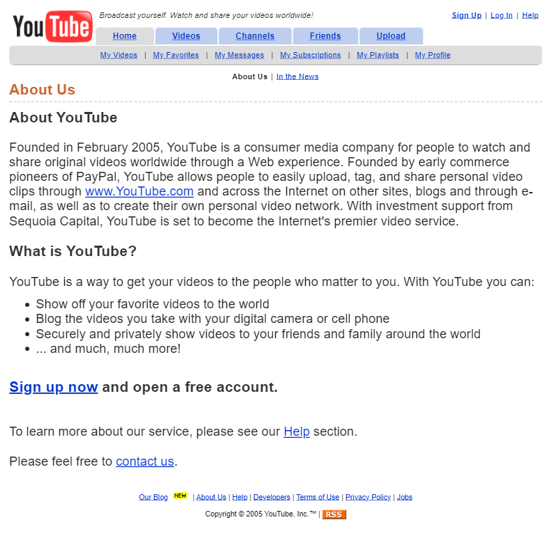
Youtube about page 2005
YouTube, about page at its official launch (December 15, 2005)

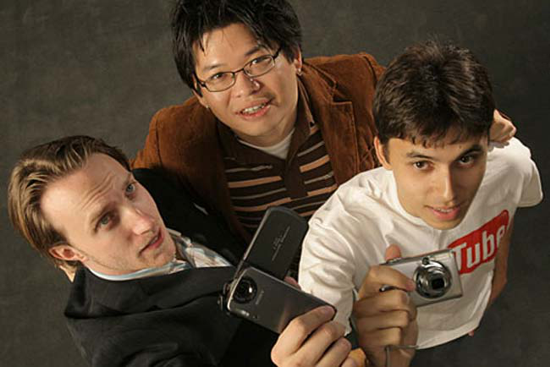
Youtube founders
Youtube developers: Chad Hurley (Reading, Jan. 24, 1977), Steve Chen (Taipei, Aug. 18, 1978), Jawed Karim (Merseburg, Oct. 28, 1979)

Youtube 10th anniversary
YouTube celebrates its 10th Anniversary (May 2005-2015) by looking back at some of the best content posted to the site, categorized from A to Z and listed in the video description

Google


First Google logo
Google logo 1997
by Sergey Brin (pre-launch version)
Project name: "BackRub" (1996)

Name: "Google" (1997)

Category: Internet

Subcategory: Search engines

Developers: Larry Page, Sergey Brin

Project developed since: March 1996

Domain registered on: September 15, 1997

Released: September 1998 - Stanford University, California, USA

Programming languages: C, C++, Java, Python

Features: The Google search engine has two important features that help it produce high precision results. First, it makes use of the link structure of the Web to calculate a quality ranking for each web page. This ranking is called PageRank. Second, Google utilizes link to improve search results.

Interesting facts: Initially, Google was nicknamed "BackRub" because the technology checks backlinks to determine a site's importance. The following name "Google" is a play on the word "googol", the mathematical term for a 1 followed by 100 zeros. In September 1998, the same month that Google was incorporated, its founders Larry Page and Sergey Brin set up office in Susan Wojcicki's garage in Menlo Park. Susan Wojcicki joined Google in 1999 as the company's first marketing manager. Google recently celebrates its birthday on 27 September, but the date has varied over the years.

Slogan (1997): «Search the web using Google!»

Property: Google Inc.

Website: http://www.google.com

BackRub
BackRub, the Google prototype (March 1996, http://backrub.stanford.edu/backrub.html)

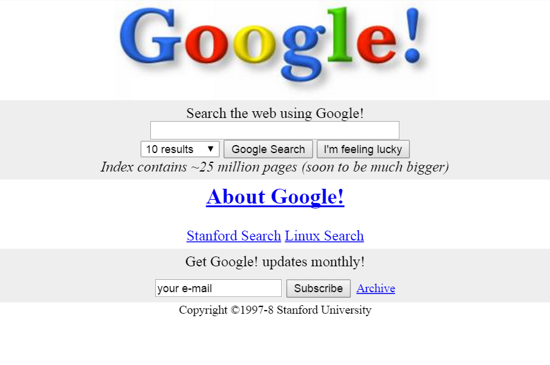
Google home page demo
Google home page demo (1997, http://backrub.stanford.edu)

Google home page on Stanford's website
Google home page on Stanford's website (1997-98, http://google.stanford.edu)

Google home page 1998
Google, first official home page (September 1998, http://www.google.com)

Older versions of Google logo
Google logo evolution 1997-98 by Sergey Brin (at the bottom in its official launch)

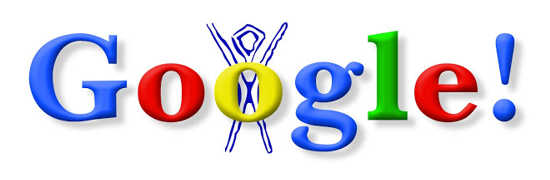
First Google Doodle 1998
The first Google "Doodle" (August 1998): a stick figure in the logo announcing to site visitors that the entire staff was playing hooky at the Burning Man Festival

Google garage
Google started in Susan Wojcicki's rented garage

Larry Page and Sergey Brin
The scientists and entrepreneurs who invented Google. Left: Lawrence "Larry" Page (East Lansing, March 26, 1973), right: Sergey Mikhaylovich Brin (Moscow, August 21, 1973).

Google 2013
Google in its advanced version (September 2015)

Google Doodle 25th Anniversary 2023
Google celebrates 25th anniversary (1998-2023) with a special Doodle that shows the evolution of the company's logos over the years

Blogger


Blogger logo 1999
Blogger logo 1999
Name: "Blogger"

Category: Internet

Subcategory: Blog host

Registered: June 22, 1999

Released: August 23, 1999

Developer / Founder: Pyra Labs (founded by Evan Williams and Meg Hourihan, acquired by Google in 2003)

Place of develop: 350 Townsend Street, San Francisco, California, USA (Pyra Labs Headquarters)

Programming language: Python

Subdomain: .blogspot.com

Features: Blogger is a blog-publishing service that allows multi-user blogs with time-stamped entries. Generally, the blogs are hosted at a subdomain of blogspot.com. Blogs can also be hosted in the registered custom domain of the blogger (like www.example.com). So blogspot.com domain publishings will be redirected to the custom domain. Blogger cannot be installed on a web server. One has to use DNS facilities to redirect a custom URL to a blogspot domain. Blogger allows its users to choose from various templates and then customize them. Users may also choose to create their own templates using CSS.

Interesting facts: Blogger was developed by a tiny company in San Francisco called Pyra. Pyra was co-founded by Evan Williams, computer programmer and Internet entrepreneur, also co-founder of Twitter, and Meg Hourihan, Internet entrepreneur, also co-founder of Kinja news aggregator. The company's first product, also named "Pyra", was a web application which would combine a project manager, contact manager, and to-do list. In 1999, while still in beta, the rudiments of Pyra were repurposed into an in-house tool which became Blogger. The service was made available to the public on August 23, 1999. Much of this coding was done by Paul Bausch and Matthew Haughey. In February 2003 Blogger was acquired by Google.

Slogan (2000): «Amphetamines for your website»

Property: Pyra.com Ltd., Google Inc.

Website: https://www.blogger.com

Blogger launch on Pyra website
Blogger, Pyra Labs launches the service from its website (see: Monday, August 23, 1999)

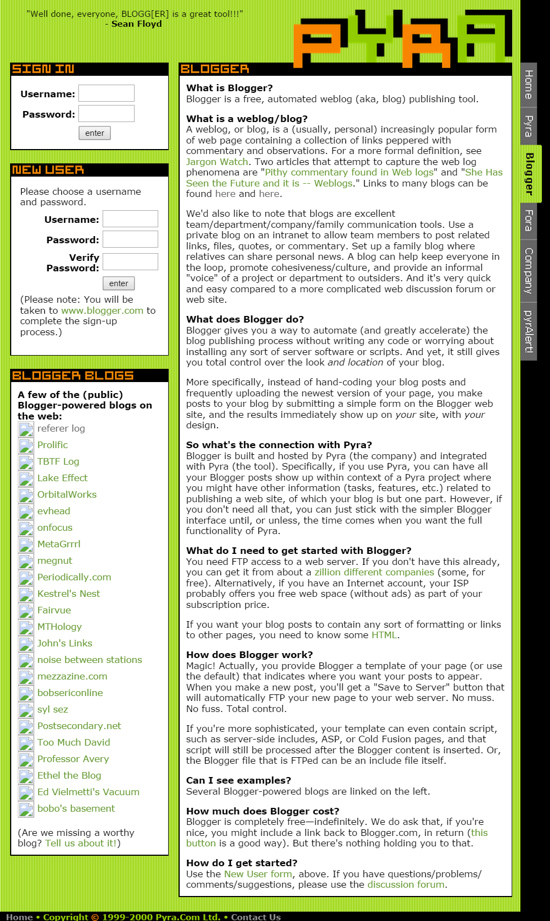
Blogger introduction on Pyra website
Blogger, about page on Pyra website (screenshot February 2000)

The first home page of Blogger
Blogger, the first home page (screenshot October 1999)

Blogger in November 2000
Blogger, restyled home page (screenshot November 2000)

Acquisition of Blogger by Google
Blogger, official announcement of acquisition by Google in February 2003: «Big news: Yes folks, it's true. As you may have read, Blogger's parent company, Pyra Labs, was purchased by Google» (screenshot March 2003)

Blogger founders
Founders of Pyra Labs, the company that created Blogger in 1999
Evan Williams, computer programmer and Internet entrepreneur, also co-founder of Twitter, and Meg Hourihan, Internet entrepreneur, also co-founder of Kinja news aggregator.

Blogger in 2015
Blogger in its advanced version (2015)

Twitter


Thefacebook logo
Twitter logo 2006
by Linda Gavin
Pre-launch version
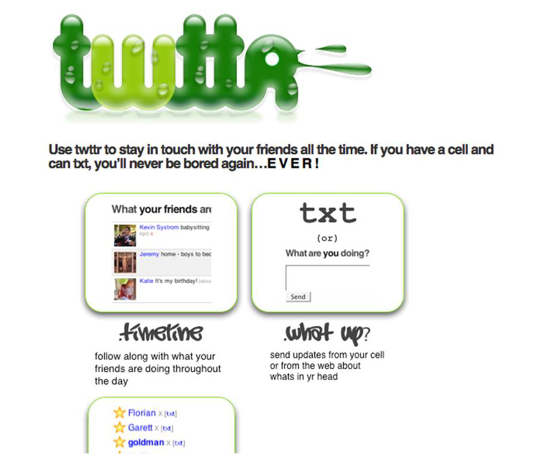
--- Name: "Twttr"
--- Domain: twttr.com
--- Registered: March 8, 2006
--- Released:
------ March 21, 2006 (internal service for Odeo employees)
------ July 15, 2006 (public service)

Launch version
--- Name: "Twitter"
--- Domain: twitter.com
--- Released: September 2006

Category: Internet

Subcategory: Social networks

Developers / Founders: Jack Dorsey, Evan Williams, Biz Stone and Noah Glass

Place of develop: San Francisco, California, USA

Programming languages: Java, Ruby, Scala, JavaScript

Features: Twitter was born as an online social networking service that enables users to send and read short messages called "tweets". Initially, each tweet was 160 characters in length, maximum; when Twitter went public, the 140 character limit was adopted because 160 characters was the SMS carrier limit and the founders wanted to leave room for a username. Registered users can read and post tweets, but unregistered users can only read them. Users access Twitter through the website interface, SMS, or mobile device app.

Interesting facts: Twitter started in 2006 when the podcasting company Odeo realized they needed to reinvent themselves and began brainstorming new creative ideas. Jack Dorsey, then an undergraduate student at New York University, introduced the idea of an individual using an SMS service to communicate with a small group. His project, which initially called "Stat.us", dated back to 2000. Later there were several different ideas for the name of the service, including "Twitch", "Friendstalker" and "Smssy", in the end the original project code name for the service was Twttr, an idea that Williams later ascribed to Noah Glass, inspired by Flickr and the five-character length of American SMS short codes. The decision was also partly due to the fact that domain twitter.com was already in use, and it was six months after the launch of Twttr that the crew purchased the domain and changed the name of the service to Twitter. Work on the project started on March 21, 2006, when Dorsey published the first Twitter message: "just setting up my twttr". The first Twitter prototype, developed by Dorsey and contractor Florian Weber, was used as an internal service for Odeo employees, and the full version was introduced publicly on July 15, 2006. In October 2006, Biz Stone, Evan Williams, Dorsey, and other members of Odeo, formed Obvious Corporation and acquired Odeo, together with its assets - including Odeo.com and Twitter.com - from the investors and shareholders. Williams fired Glass, who was silent about his part in Twitter's startup until 2011. Twitter spun off into its own company in April 2007.

Slogan (2006): «A global community of friends and strangers answering one simple question: What are you doing?»

Property: Twitter Inc.

Website: https://twitter.com

Twitter sketch by Jack Dorsey
Twitter, a sketch by Jack Dorsey (2001). His project, called "Stat.us", dated back to 2000.

Twitter interface March 2006
Twitter in March 2006, used as an internal service for Odeo employees

Twitter home page July 2006
Twitter interface July 2006
Twitter in July 2006, launched as public service under the name "Twttr"

Twitter interface November 2006
Twitter in November 2006, with its official "blue bubbly" logo

The first "automated" tweet ever: «just setting up my twttr»
(from co-founder Jack Dorsey - https://twitter.com/jack/status/20 - March 21, 2006)

The first "human" tweet ever: «inviting coworkers»
(from co-founder Jack Dorsey - https://twitter.com/jack/status/29 - March 21, 2006)

Early Twitter logo
Twitter logo experiments 2006 (at right-bottom in its official launch). Most of the early logos were designed by co-founder Biz Stone, the first version he explored was a red jagged oval with off kilter letters cut out in white. Below the logo sat the tagline: "An Odeo Thingy". The "blue bubbly" logo was created by graphic designer Linda Gavin.

Twitter promo video (July 24, 2006). Co-founder Biz Stone explains what Twitter is in a hilarious short video on YouTube: "Twitter 101 or twttr 101".

Twitter founders
Twitter founders. From left: Jack Dorsey, Evan Williams, Christopher "Biz" Stone, Noah Glass.

Twitter interface November 2006
Twitter in its advanced version (2015)